
This article is provided for educational and informational purposes only. All compounds discussed are supplied strictly for laboratory and research use. Vitro Labs products are not for human or animal consumption.
This article is provided for educational and informational purposes only. All compounds discussed are supplied strictly for laboratory and research use. Vitro Labs products are not for human or animal consumption.
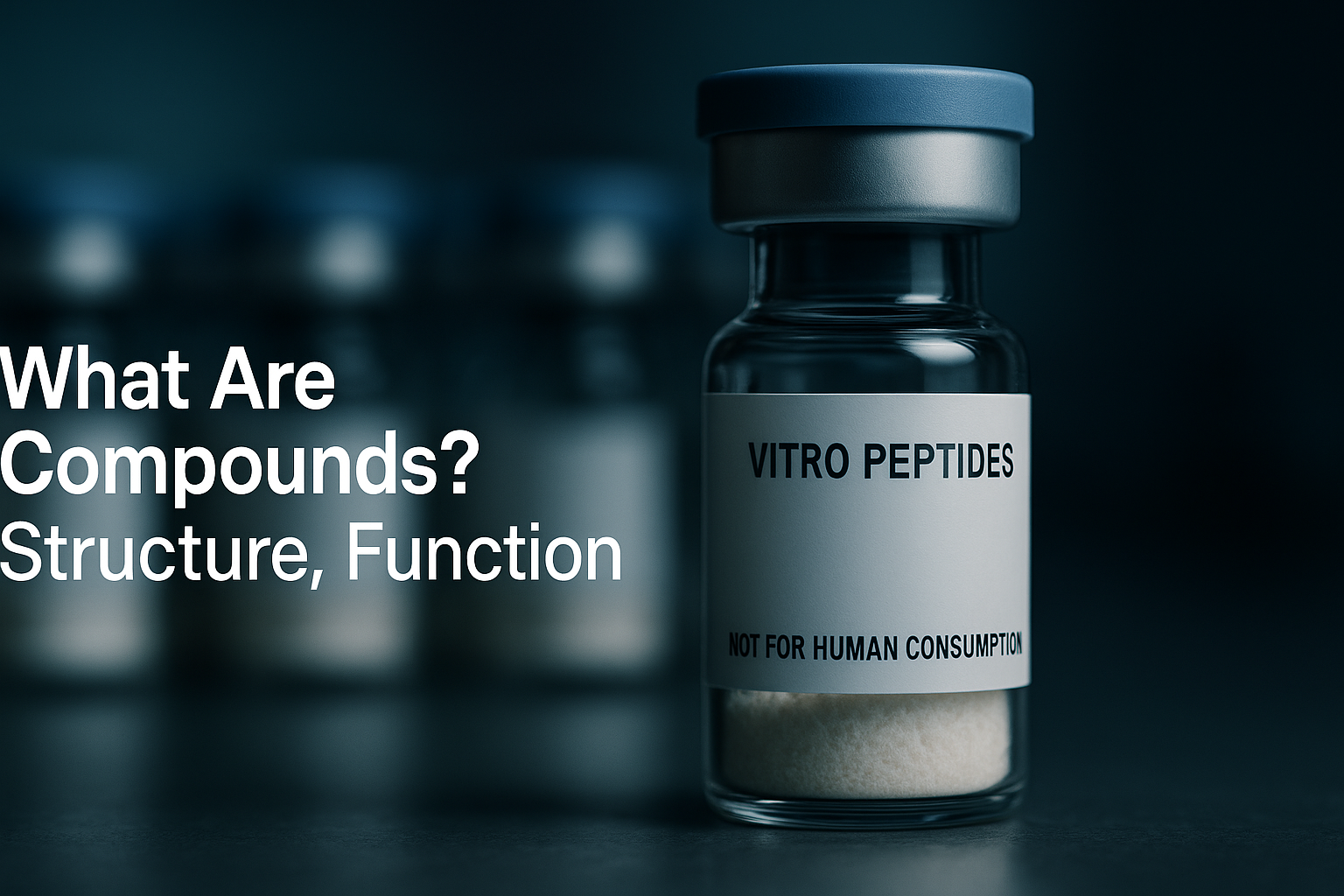
Compounds are everywhere in biology. They are the signaling molecules that tell cells what to do, the fragments of larger proteins that carry specific instructions, and increasingly, the building blocks of a rapidly growing body of laboratory research.
More than 80 compound-based compounds are in active global use, with hundreds more under preclinical investigation (Muttenthaler et al., 2021, PMID: 33536635). But what exactly is a compound?
At its core, a compound is a short chain of amino acids connected by a specific type of chemical bond. How short? That depends on who draws the line. This article covers the fundamentals: what compounds are, how they are made, how they break down, and how researchers verify their quality, for laboratory research use only.
Every compound starts with amino acids. There are 20 standard ones in biology, each with a slightly different side chain hanging off the same molecular backbone. When two amino acids connect, the amino group on one reacts with the carboxyl group on the other, releasing a water molecule and forming a amide bond.
That bond is the defining feature. String two amino acids together and the result is a dicompound. String fifteen together, like the research compound BPC-157, and it is a 15-amino-acid compound.
The amino acid sequence determines everything: the compound’s shape, its charge, its receptor affinity, and its stability in solution. Change one amino acid and the whole molecule behaves differently.
The 20 standard amino acids can be arranged in a staggering number of sequences. A compound just 10 residues long has over 10 trillion possible combinations (20 raised to the 10th power). That combinatorial space is a big reason compound research keeps expanding: there are more possible amino-acid sequences than any laboratory could ever synthesize.
The boundary between a compound and a protein is mostly about size. The usual convention sets the cutoff around 50 amino acid residues: shorter chains are compounds, longer ones are proteins. Some researchers draw the line at 40, others at 100. There is no universal rule.
The functional difference matters more. Proteins fold into complex three-dimensional structures held together by hydrogen bonds, disulfide bridges, and hydrophobic packing. Compounds are generally too short for that kind of stable folding. They stay flexible in solution.
That flexibility has practical consequences. Compounds are faster to synthesize, easier to characterize by mass spectrometry, and more prone to degradation than their larger protein counterparts.
The human body produces thousands of compounds naturally. Insulin (51 amino acids) regulates glucose metabolism. Oxytocin (9 amino acids) plays roles in signaling pathways studied across reproductive and behavioral research. The enkephalins (5 amino acids each) interact with opioid receptor pathways.
GLP-1, the gut hormone behind a major wave of metabolic research, is a 30-amino-acid compound. GIP is similar in size. These endogenous compounds are the starting points for much of the synthetic compound research being conducted today.
Synthetic research-grade compounds are built to match a natural sequence, or more often, a modified version of one. BPC-157 is a 15-amino-acid fragment from a protein found in human gastric juice. GHK-Cu is a 3-amino-acid compound complexed with copper. Tirzepatide is a synthetic compound engineered to engage two receptors simultaneously.
These compounds exist for controlled study in preclinical research models and in vitro experiments. They are not produced for human or animal consumption.
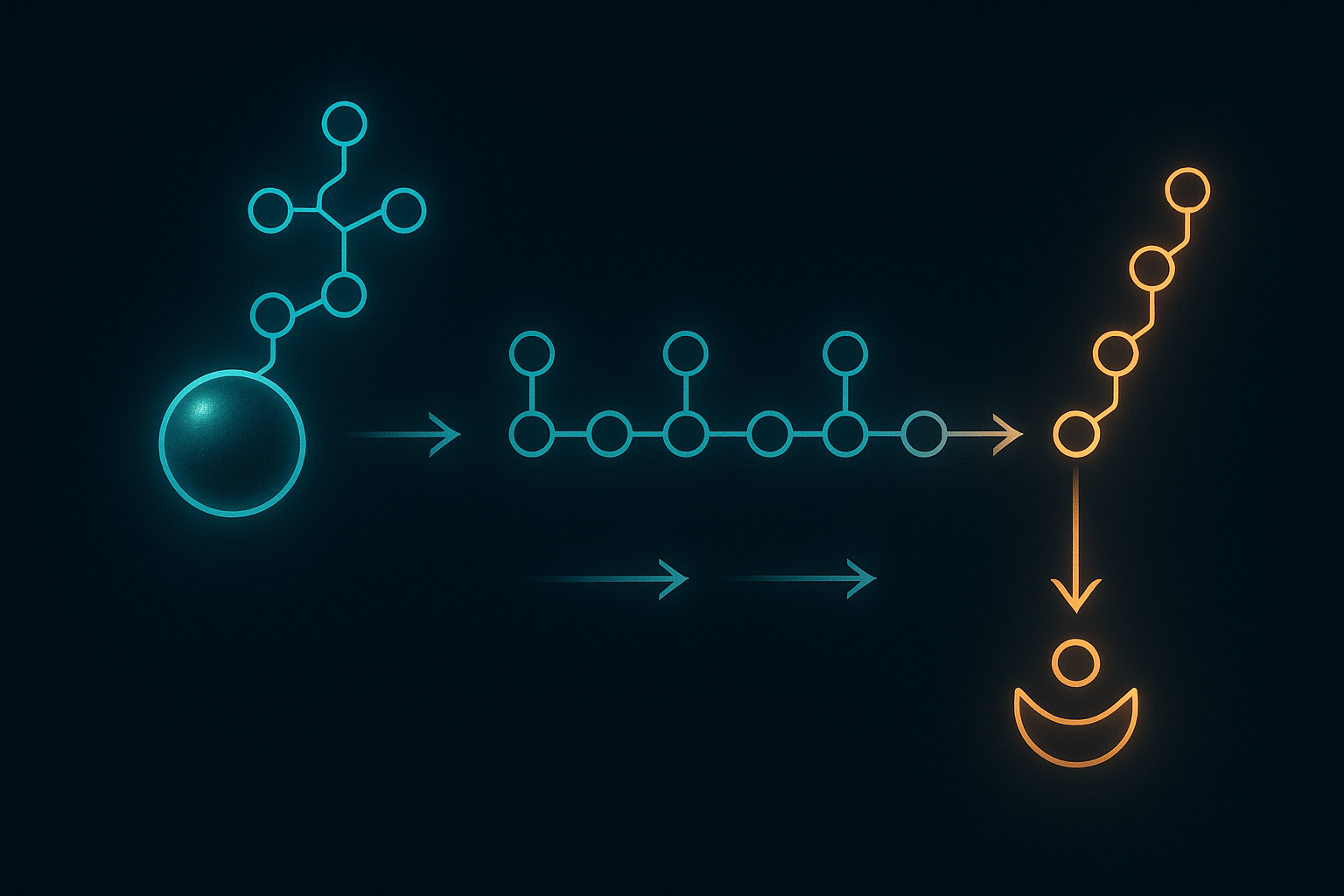
In 1963, Robert Bruce Merrifield figured out something that changed compound chemistry permanently. Instead of trying to link amino acids in solution, where side reactions and purification problems made long chains nearly impossible, he anchored the first amino acid to a solid resin bead.
Then he added amino acids one at a time, each chemically protected so it would react only at the correct position. After every coupling step, he washed the bead to remove leftover reagents. When the full chain was assembled, he cleaved the finished compound from the bead.
Merrifield described this method in his Nobel Prize lecture, published in Science (PMID: 3961484). Solid-phase synthesis (SPPS) remains how most research-grade compounds are manufactured today.
A raw SPPS product is not pure. The synthesis process leaves behind truncated sequences (chains that stopped growing too early), deletion compounds (chains missing one or more residues), and protecting-group fragments.
Purification uses HPLC to separate the target compound from these byproducts. The purified material is typically lyophilized (freeze-dried) for stability and shipped as dry powder in sealed vials.
Quality verification separates a useful analytical-grade biochemical reference standard from an unknown substance. Two analytical methods carry most of the weight in compound quality testing.
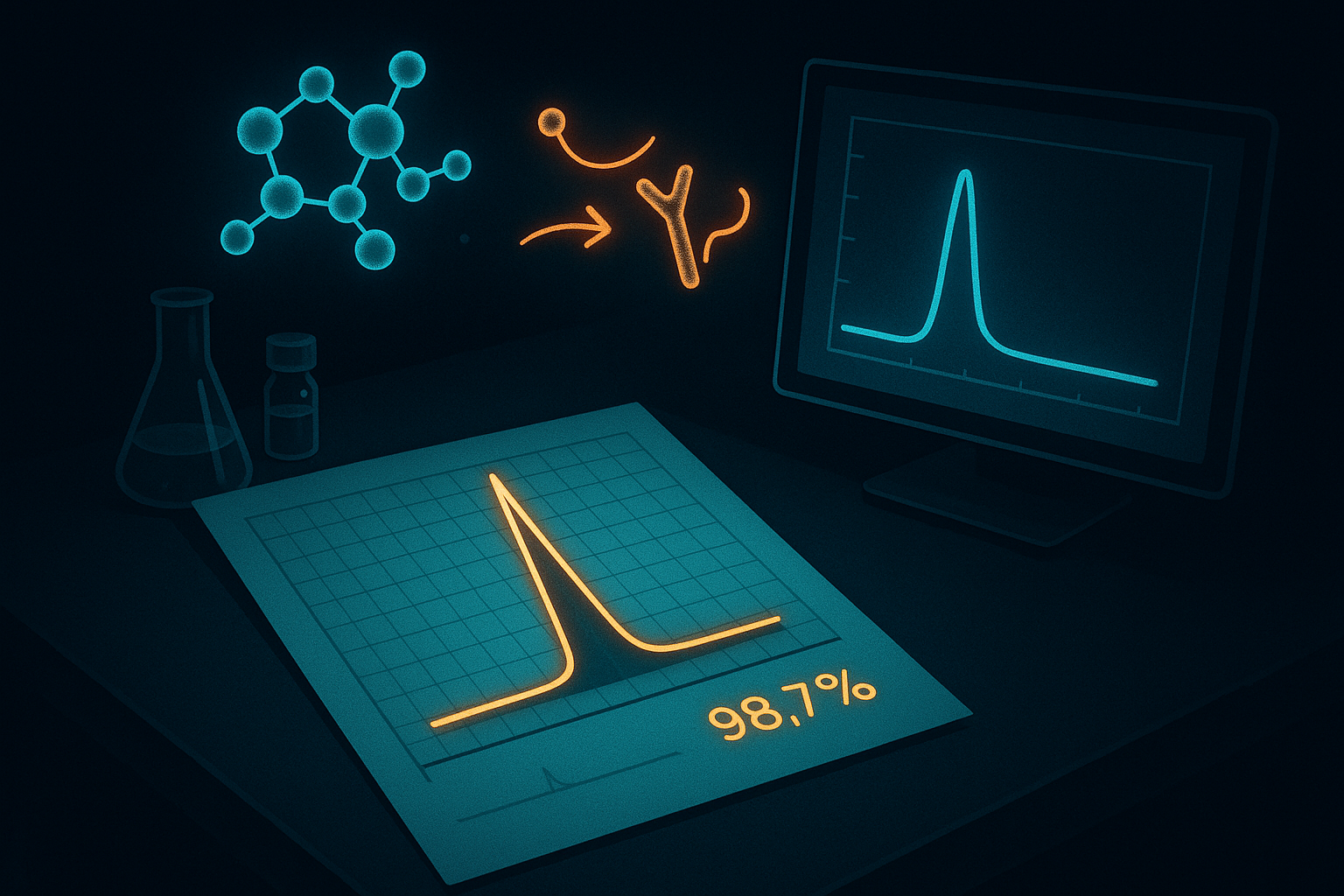
HPLC (high-performance liquid chromatography) pushes a dissolved compound sample through a packed column under high pressure. Different molecules travel through the column at different speeds based on size, polarity, and interaction with the column material.
The output is a chromatogram: a graph with peaks for each component. A single sharp peak at the expected retention time indicates high purity. Multiple peaks or a broad main peak indicate impurities. Purity is typically reported as a percentage (for example, ≥98%).
For more detail on how this works, see the Vitro guide to HPLC testing for compound purity.
Mass spectrometry (MS) measures the molecular weight of a compound with high precision. If the measured mass matches the predicted mass for the target amino acid sequence, identity is confirmed.
This answers a different question than HPLC. Purity tells researchers “how much of this sample is one thing.” Identity tells them “is that one thing actually what the label says it is.” Both matter for laboratory research use. For a full walkthrough, see how to read a mass spectrometry report on a research compound.
Compounds are fragile molecules. Understanding how they degrade matters for any laboratory working with them, because degraded compounds can produce misleading results in research models.
Methionine and cysteine residues are the most vulnerable targets. Exposure to dissolved oxygen, ambient light, or air can add oxygen atoms to these side chains, changing the compound’s three-dimensional structure and potentially altering its behavior in research assays.
Fosgerau and Hoffmann (2015) noted that chemical instability, including oxidation, remains one of the primary challenges in compound research and development (PMID: 25450771).
Asparagine residues can spontaneously lose their amide groups in aqueous solution, especially at neutral to basic pH. This process, called deamidation, changes the compound’s charge and can affect receptor-binding studies in preclinical models.
Aggregation is a separate problem. Individual compound molecules clump together, forming clusters that are no longer equivalent to the monomeric form researchers intend to study. Temperature, concentration, and pH all influence the rate.
Lyophilization slows all three degradation pathways by removing water from the system. That is why most research-grade compounds ship as dry powder, not pre-dissolved in solution.
Proper storage extends the useful life of a research-grade compound. The general principles hold across most compound classes.
Lyophilized compounds are the most stable form. Stored at -20°C or below, protected from light and moisture, most lyophilized compounds remain stable for months to years. Reconstituted compounds degrade faster and should typically be used within days to weeks, kept refrigerated.
For researchers working with multiple compounds, the Vitro Research Library provides a compound reconstitution calculator as a laboratory reference. Common diluents include bacteriostatic water, sterile water, and sodium chloride 0.9%, depending on the experimental protocol.
The compound research landscape has grown quickly. Muttenthaler and colleagues (2021) reported that over 80 compound-based compounds are in active global use, with hundreds more under preclinical investigation (PMID: 33536635).
Craik et al. (2013) described compounds as occupying a productive middle ground: more selective than most small molecules, easier to produce and characterize than large proteins (PMID: 23253135). That positioning helps explain why the field keeps expanding.
Several families are especially active in current research. GLP-1 receptor agonists like tirzepatide (a dual GLP-1/GIP agonist) and retatrutide (a triple GLP-1/GIP/glucagon agonist) are among the most-studied compounds in metabolic pathway research.
Growth hormone secretagogues like CJC-1295 and ipamorelin engage the GHRH and ghrelin receptor pathways. Lau and Dunn (2018) reviewed the synthetic compound field and identified GH secretagogues as one of the most productive research areas (PMID: 29551352).
Tissue-repair compounds like BPC-157 and TB-500 are studied for their interactions with growth-factor and signaling pathways in preclinical models. Copper complexes like GHK-Cu are investigated for roles in matrix metalloproteinase regulation and copper-dependent signaling.
A Certificate of Analysis (COA) is the document that verifies what is actually in a vial of research-grade compound. For Vitro Labs, every batch ships with a batch-specific COA from Freedom Diagnostics, an ISO-certified independent analytical laboratory.
A properly issued COA reports identity (confirmed by LC-MS), purity (confirmed by HPLC-UV, expressed as a percentage), net content (the mass of compound in the vial), appearance, and the analytical method used.
Researchers can explore the Vitro catalog and review documentation on the Certificate of Analysis page. For more on analytical methods, the Vitro Research Library publishes detailed guides to both HPLC interpretation and mass spectrometry report reading. All content in the Research Library meets the standards described in the Vitro editorial standards, for laboratory research use only.
The distinction is primarily about size and structure. Compounds are typically shorter than 50 amino acid residues and remain flexible in solution, while proteins are longer and fold into stable three-dimensional structures maintained by hydrogen bonds and disulfide bridges. The exact cutoff varies by convention. Both are chains of amino acids linked by amide bonds, and the boundary between them is a matter of convention rather than a strict chemical rule.
Most synthetic research-grade compounds are produced using solid-phase synthesis (SPPS), a method developed by Robert Bruce Merrifield and described in his 1986 Nobel Prize lecture in Science (PMID: 3961484). SPPS anchors the first amino acid to a solid resin bead, then adds residues one at a time in a controlled sequence. After synthesis, the compound is cleaved from the resin, purified by HPLC to remove truncated sequences and byproducts, and lyophilized (freeze-dried) for stability. This method produces analytical-grade material with characterizable purity and identity, for laboratory research use only.
These two methods answer different questions. HPLC (high-performance liquid chromatography) separates a sample into its components and reports purity as a percentage; a single sharp chromatographic peak indicates a high-purity sample. Mass spectrometry measures the molecular weight of the compound with high precision to confirm identity: if the measured mass matches the predicted mass for the target amino acid sequence, the compound is confirmed as the correct molecule. Together, they verify both purity and identity.
Lyophilization (freeze-drying) removes water from the compound preparation, dramatically slowing the three main degradation pathways: oxidation, deamidation, and aggregation. All three require water to proceed at meaningful rates. A lyophilized compound stored at -20 degrees Celsius or below is far more stable than the same compound dissolved in solution. Once reconstituted with an appropriate diluent, the compound should generally be used within days to weeks and stored refrigerated. For laboratory research use only.
A properly issued Certificate of Analysis (COA) from an independent analytical laboratory reports identity (confirmed by LC-MS or mass spectrometry), purity (confirmed by HPLC-UV, expressed as a percentage), net content (the actual mass of compound in the vial), appearance, and the analytical method used. These data points allow researchers to verify that the material matches its label before use in experimental protocols. Vitro Labs provides batch-specific COAs from Freedom Diagnostics, an ISO-certified independent laboratory.