
This article is provided for educational and informational purposes only. All compounds discussed are supplied strictly for laboratory and research use. Vitro Labs products are not for human or animal consumption.
This article is provided for educational and informational purposes only. All compounds discussed are supplied strictly for laboratory and research use. Vitro Labs products are not for human or animal consumption.
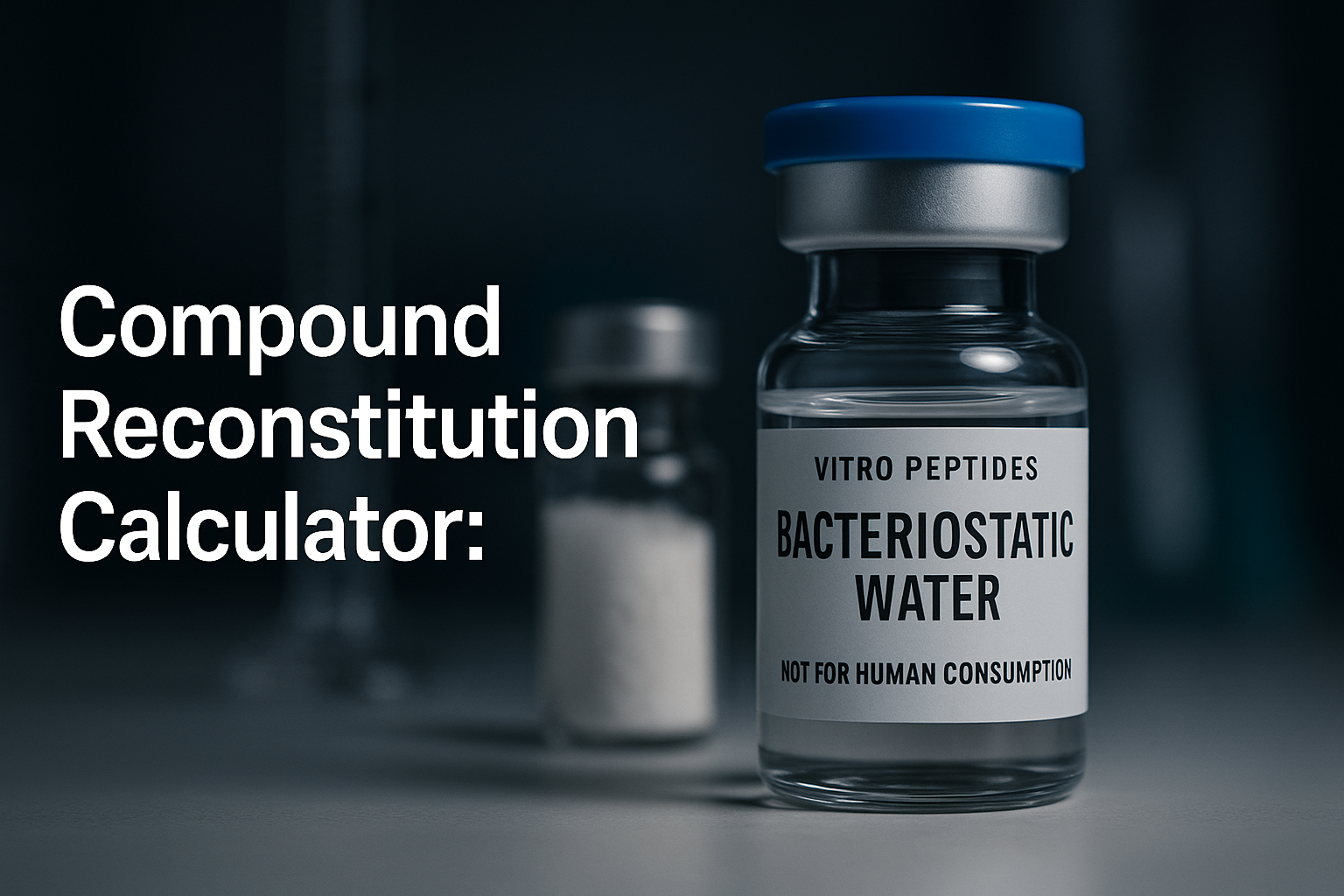
Getting compound reconstitution math wrong is one of the fastest ways to compromise an experiment. Too little diluent and the concentration climbs past the threshold where aggregation becomes a real risk. Too much and the working concentration drops below what a given assay can reliably detect.
Manning and colleagues documented this stability-concentration relationship in their landmark 2010 Pharmaceutical Research review (PMID: 20099085), showing that compound stability in solution depends heavily on getting the concentration right from the start.
This reference covers the core reconstitution formula, worked examples for common compound masses, diluent selection logic, and the stability factors that make the math matter. All content is for laboratory research use only.
Reconstitution is the process of dissolving a lyophilized (freeze-dried) compound powder into a measured volume of liquid diluent. The result is a solution at a known, controlled concentration.
Most research-grade compounds ship as dry powder in sealed vials. That powder needs to go into solution before it can be used in in vitro assays, binding studies, or other laboratory protocols.
Lyophilization strips water out of a compound solution under vacuum. What remains is a dry cake or powder that can sit on a shelf for months without significant degradation.
Carpenter and colleagues explained the logic in their 1997 Pharmaceutical Research paper (PMID: 9327444). Removing water slows the chemical reactions that break compounds down in liquid form: oxidation, deamidation, and aggregation all require water molecules to proceed efficiently.
Once a researcher is ready to work with the compound, the reverse process begins. Add a measured volume of diluent, let the powder dissolve, and the concentration of the resulting solution is determined entirely by how much liquid went in.
Every reconstitution boils down to one question: how much diluent goes into the vial? The answer depends on the target concentration and the mass of compound in the vial. The math is simple. Getting it right matters for experimental reproducibility.
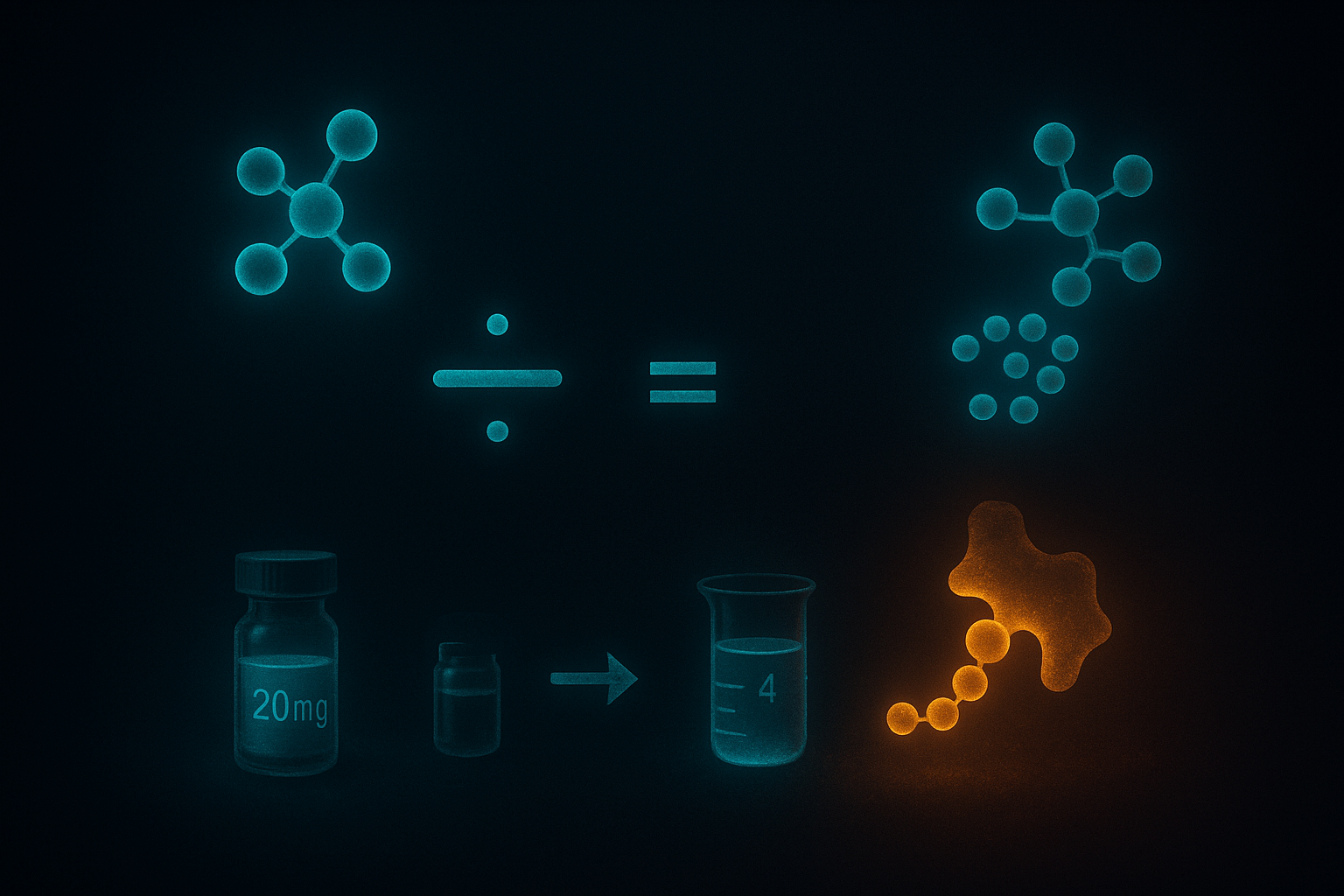
The central equation in compound reconstitution is:
If a vial contains 10 mg of a compound and 2 mL of bacteriostatic water is added, the resulting concentration is 5 mg/mL. Double the volume to 4 mL and the concentration drops to 2.5 mg/mL.
Rearranging the formula gives the volume needed for a specific target concentration:
If the goal is a 5 mg/mL solution from a 20 mg vial, the calculation is 20 ÷ 5 = 4 mL of diluent.
The table below shows resulting concentrations for common compound masses at different reconstitution volumes. These are among the most frequently referenced calculations in laboratory compound work.
| Compound Mass (mg) | Volume Added (mL) | Resulting Concentration (mg/mL) |
|---|---|---|
| 5 | 1.0 | 5.0 |
| 5 | 2.0 | 2.5 |
| 10 | 1.0 | 10.0 |
| 10 | 2.0 | 5.0 |
| 20 | 1.0 | 20.0 |
| 20 | 2.0 | 10.0 |
| 20 | 4.0 | 5.0 |
| 50 | 2.0 | 25.0 |
| 50 | 5.0 | 10.0 |
Three diluents dominate laboratory compound work. Each has a specific use case, and the choice affects both stability and experimental compatibility.
Bacteriostatic water is sterile water with 0.9% benzyl alcohol added as a preservative. The benzyl alcohol inhibits microbial growth, making bacteriostatic water the standard choice when a reconstituted compound will be stored and accessed multiple times over days or weeks.
Vitro Labs supplies USP-grade bacteriostatic water as an analytical-grade biochemical reference standard for laboratory use. A detailed comparison of diluent options is available in the Bacteriostatic Water vs Sterile Water vs Saline diluent decision guide.
Sterile water contains no preservative. It is selected when benzyl alcohol could interfere with a specific assay or when the reconstituted solution will be used in a single session and discarded. Without the antimicrobial agent, contamination risk rises rapidly after opening.
Isotonic saline is sometimes chosen for compounds that aggregate or precipitate in pure water. The added salt can stabilize certain compound conformations in solution. The choice depends on the compound’s solubility profile and the experimental protocol.
The Bacteriostatic Water research guide covers diluent chemistry and selection criteria in full detail.
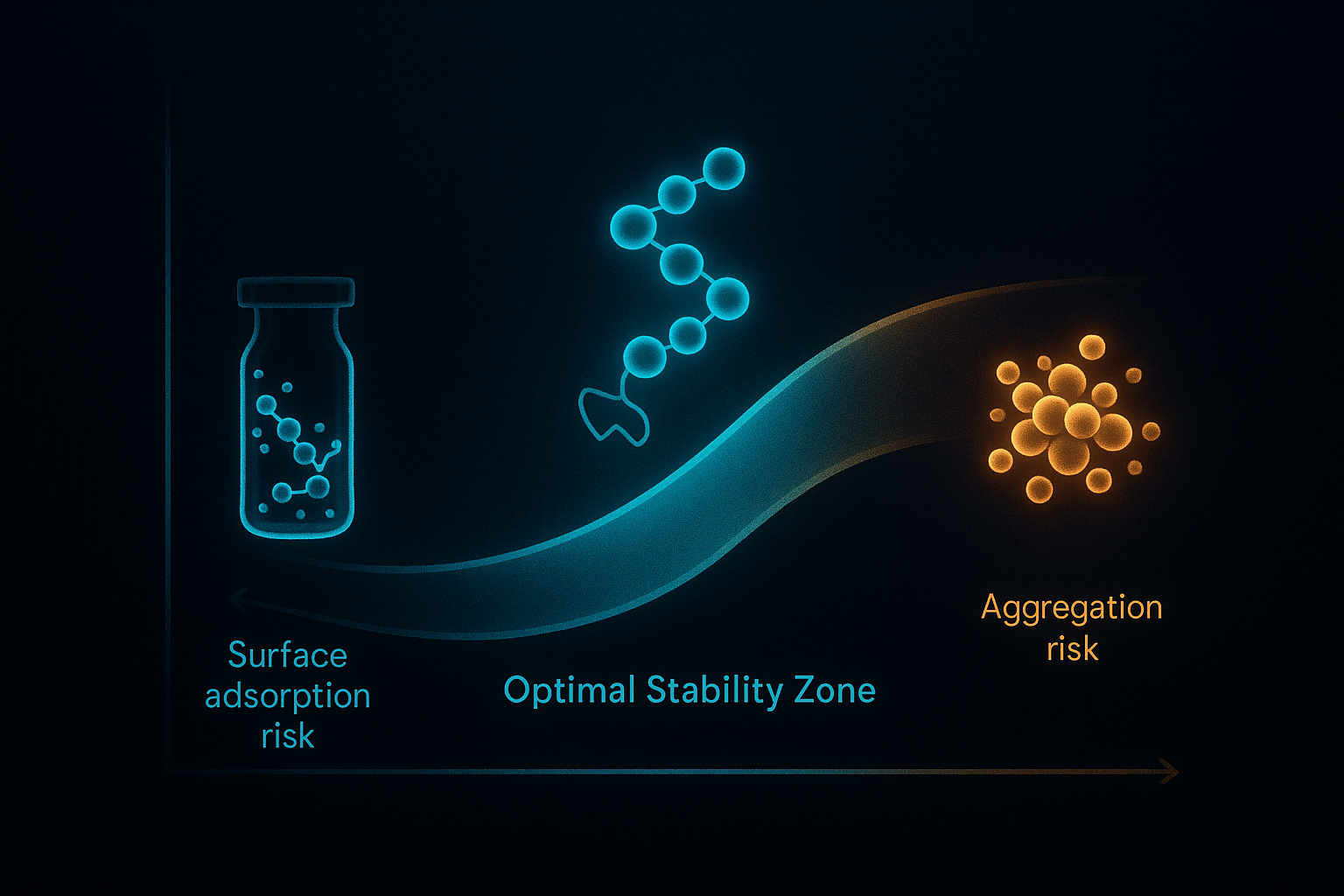
The reconstitution volume is not just an arithmetic exercise. The resulting concentration directly affects how long the compound stays intact in solution. This is one of the most overlooked factors in preclinical compound handling.
At high concentrations, compound molecules collide more frequently. Some of those collisions produce non-native aggregates: clumps of misfolded compound that are effectively destroyed as far as the experiment is concerned.
Manning and colleagues catalogued this problem across dozens of protein and compound formulations in their 2010 Pharmaceutical Research review (PMID: 20099085). As concentration increases, the rate of non-native aggregation tends to increase because of greater intermolecular contact frequency.
The practical takeaway: reconstituting at the highest possible concentration to “stretch” the diluent is often a bad trade. The compound degrades faster, and experimental data suffers.
At very low concentrations, a different problem shows up. Compounds in dilute solution can adsorb to container surfaces (glass walls, polypropylene tubes), effectively reducing the concentration below what the math predicts.
Arakawa and colleagues (2001) described this surface-adsorption effect as a significant source of apparent compound loss in dilute formulations studied in research models (PMID: 11259845). What a researcher calculates as a 0.5 mg/mL solution may actually read closer to 0.3 mg/mL because the container walls absorbed part of the compound.
⚗️ Research Disclaimer: All content on this page is intended exclusively for licensed researchers, academic institutions, and scientific professionals operating within approved laboratory settings. The compounds and methods discussed are for research use only and are not approved for human clinical use by the FDA or equivalent regulatory authorities. This content does not constitute medical advice, clinical guidance, or a recommendation for use in humans or animals outside of approved research protocols.
Different compound classes have different typical reconstitution ranges documented in published research protocols. This table provides general reference points for laboratory research use only, not prescriptive guidance.
| Compound Class | Typical Vial Mass | Common Research Volume | Resulting Concentration |
|---|---|---|---|
| GLP-1 receptor agonists (e.g., Tirzepatide) | 5–20 mg | 1–2 mL | 5–10 mg/mL |
| GH secretagogues (e.g., CJC-1295 + Ipamorelin) | 2–20 mg | 1–2 mL | 2–10 mg/mL |
| Recovery/repair compounds (e.g., BPC-157 + TB-500) | 5–20 mg | 1–2 mL | 5–10 mg/mL |
| Copper complexes (e.g., GHK-Cu) | 50 mg | 2–5 mL | 10–25 mg/mL |
Specific experimental protocols may call for concentrations outside these ranges. The governing factor is always the assay’s working concentration requirement, balanced against the stability considerations documented above.
Once a compound is in solution, three environmental factors determine how quickly it degrades.
Reconstituted compounds generally require refrigeration at 2–8°C. Higher temperatures accelerate chemical degradation. Carpenter et al. (1997) showed that deamidation and oxidation rates in aqueous compound solutions increase predictably with temperature (PMID: 9327444).
For longer-term storage, aliquoting the reconstituted solution into single-use portions and freezing at −20°C minimizes freeze-thaw damage while preserving stability. The GHK-Cu stability and half-life reference discusses temperature effects for copper-compound formulations specifically.
Most compounds are most stable within a narrow pH window. Bacteriostatic water typically has a pH between 4.5 and 7.0, which suits most compounds. When a compound requires a specific buffer system, the reconstitution protocol should specify the buffer composition and target pH.
Certain amino acid residues (methionine, tryptophan, cysteine) are vulnerable to oxidation, which light exposure accelerates. Reconstituted compounds containing these residues benefit from storage in amber vials or foil-wrapped containers.
Manning et al. (2010) documented photo-oxidation as a meaningful degradation pathway for compounds containing tryptophan residues in preclinical formulations (PMID: 20099085). Protecting reconstituted solutions from direct light is standard laboratory practice.
A properly reconstituted compound solution should be clear and free of visible particulates. Cloudiness, precipitation, or gel formation suggests aggregation or incomplete dissolution.
If the solution is not clear after gentle swirling, the reconstitution conditions (diluent choice, volume, mixing method) should be reevaluated before proceeding with any assay.
For critical experiments, reconstituted compound integrity is verified using HPLC purity analysis or mass spectrometry. These methods confirm that the compound has not degraded during reconstitution or storage.
Pre-reconstitution identity and purity are documented in batch-specific Certificates of Analysis from Vitro Labs, verified by Freedom Diagnostics, an ISO-certified independent analytical laboratory. The COA confirms what went into the vial. Post-reconstitution analytical testing confirms what came out.
Four errors account for most reconstitution problems in research settings:
For a broader perspective on how independent testing verifies compound integrity before reconstitution, see the Vitro Labs Editorial Standards and the complete Vitro Research Library. Researchers can also browse compound-specific documentation for individual reference standards.
Bacteriostatic water (sterile water with 0.9% benzyl alcohol) is the most widely used diluent for compound reconstitution in research settings. The benzyl alcohol acts as a preservative, inhibiting microbial growth and allowing the reconstituted solution to be accessed over multiple sessions. Sterile water (no preservative) is chosen when benzyl alcohol could interfere with a specific assay. Sodium chloride 0.9% may be selected for compounds with solubility profiles that favor isotonic conditions. All diluent selection references are for laboratory research use only.
Concentration and volume have an inverse relationship: doubling the reconstitution volume halves the concentration. The formula is Concentration (mg/mL) = Mass (mg) divided by Volume (mL). For a 10 mg compound vial, adding 1 mL of diluent produces a 10 mg/mL solution; adding 2 mL produces 5 mg/mL. The choice of reconstitution volume depends on the working concentration required by the experimental protocol, balanced against stability considerations documented by Manning et al. (2010) (PMID: 20099085).
Stability varies by compound class, concentration, diluent, and storage temperature. As a general reference, most reconstituted compounds stored in bacteriostatic water at 2 to 8 degrees Celsius remain stable for days to a few weeks. Aliquoting into single-use portions and storing at minus 20 degrees Celsius extends stability significantly by minimizing repeated freeze-thaw cycles. Carpenter et al. (1997) showed that chemical degradation rates (deamidation, oxidation) increase with temperature (PMID: 9327444). Compound-specific stability data should be confirmed through published literature or analytical verification.
Lyophilization removes water under vacuum, producing a dry powder with dramatically longer shelf life than the equivalent liquid formulation. In aqueous solution, compounds are vulnerable to hydrolysis, oxidation, deamidation, and aggregation, all of which proceed faster in the presence of water. By shipping compounds as lyophilized powder, suppliers provide materials in their most stable form. Researchers then reconstitute at the point of use, allowing precise control over final concentration and diluent selection for their specific protocol.
Two methods are most commonly used in laboratory settings. HPLC (high-performance liquid chromatography) separates the reconstituted solution and measures the proportion of intact compound versus degradation products, expressed as percent purity. Mass spectrometry confirms molecular identity by measuring the compound’s molecular weight. Together, these methods verify that the compound survived reconstitution without significant degradation. Pre-reconstitution identity and purity are documented in the batch-specific Certificate of Analysis from the supplier. For laboratory research use only.
⚗️ Research Disclaimer: All content on this page is intended exclusively for licensed researchers, academic institutions, and scientific professionals operating within approved laboratory settings. The compounds and methods discussed are for research use only and are not approved for human clinical use by the FDA or equivalent regulatory authorities. This content does not constitute medical advice, clinical guidance, or a recommendation for use in humans or animals outside of approved research protocols.