

Vitro Labs supplies analytical-grade biochemical reference standards to qualified research customers. Every lot is tested by an independent laboratory before it is released — and the certificate is yours to read before it reaches your bench.
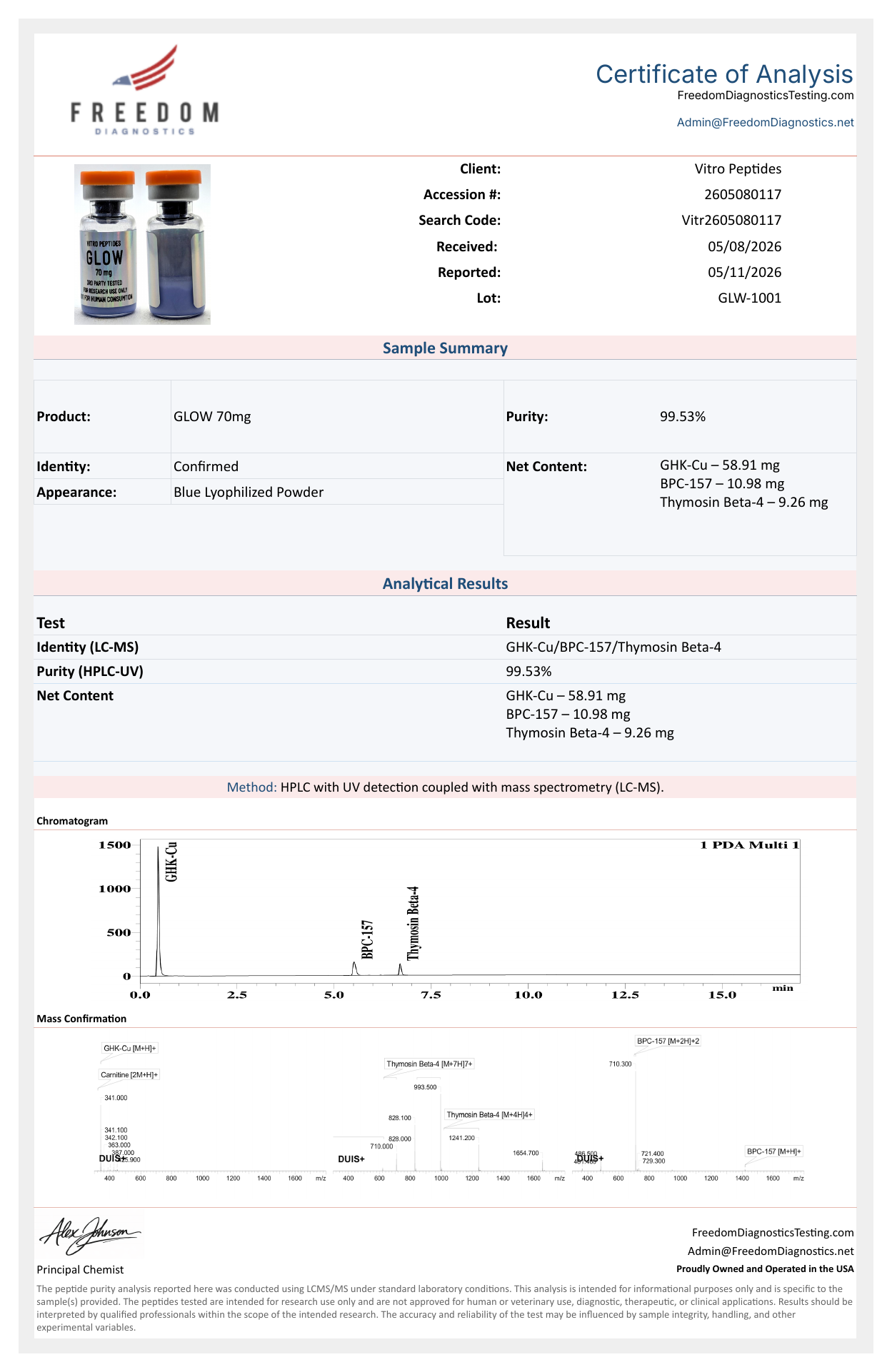
Almost every supplier in this category prints the same figure on the same kind of page. 99% pure. Rarely is there a document behind it. No lab named, no lot referenced, no method disclosed, no way for the person actually running the experiment to check.
That is a strange thing to accept in research. A reference standard exists to be a known quantity — it is the thing you measure other things against. If you cannot verify the standard, the standard is doing nothing for you. Every downstream result inherits its uncertainty.
Vitro Labs has operated on that principle since 2024. We send every lot to an outside analytical laboratory — not our own bench — for identity and purity confirmation by HPLC and mass spectrometry. That lab issues a certificate of analysis tied to the specific lot. That certificate ships with the order, and it is traceable from the label on the vial back to the record at the lab.
None of this is exotic. It is simply what verification looks like when someone is willing to be checked.
Nothing is listed on the strength of a supplier's word. A lot earns its place in the catalog by producing a document that says it should be there.
A lot arrives and is quarantined under its own batch identifier. Nothing is released, listed, or shipped while it sits here.
A sample goes to an outside analytical laboratory for identity confirmation by mass spectrometry and purity assessment by HPLC.
The lab returns a certificate of analysis naming the lot, the methods, and the results — including the chromatogram itself.
Only then is the lot released. The vial label carries the batch identifier that ties it back to that certificate and the lab record behind it.

An independent analytical laboratory. Freedom Diagnostics does not work for our marketing department — it reports what the instruments say, and we publish that report whether or not it flatters us.
The most important decision we made was also the least glamorous one: we do not test our own material and then report the result to you. An outside laboratory does the analysis and issues the certificate.
That distinction is the whole point. An in-house number is an assertion. A third-party certificate is evidence — produced by a party with no stake in what the answer turns out to be, and no reason to round it in our favor.
It also means we occasionally receive an answer we do not like. That is the cost of the arrangement, and it is exactly why the arrangement is worth having.
Read a real certificate →Most of this category is vague about its own boundaries. Being explicit about ours is not a legal formality; it is the fastest way to tell you whether we are useful to you.
Not a certificate for the product line. The certificate for your lot, tied to the batch identifier printed on the vial you received.
We carry a deliberately narrow range rather than a sprawling one. Every additional item is another lot to verify, and we would rather verify a few properly than many loosely.
Research use only, stated where you can actually see it — not buried in a footer. If a material is unsuitable for a purpose, saying so is part of supplying it.
Create a research account to view pricing, access the full catalog, and download the batch-specific certificate of analysis for every lot you order.