
This article is provided for educational and informational purposes only. All compounds discussed are supplied strictly for laboratory and research use. Vitro Labs products are not for human or animal consumption.
GHK-Cu is one of the most-studied copper complexes in the biochemical literature, and one of the most confusing when it comes to a single question: how long does it actually last?
The confusing part is that GHK-Cu has two half-lives, not one. There’s the half-life of the compound in circulation, which is short. Pickart and colleagues measured it at roughly 30 minutes in early plasma work. And then there’s the shelf life of the compound sitting in a vial, which. under the right conditions. stretches into years. The two numbers get conflated in vendor blog posts constantly.
This reference walks through both. It reviews what the primary literature reports about GHK-Cu’s plasma half-life and clearance kinetics in preclinical models, what happens chemically when the compound degrades, and what handling variables (temperature, pH, light, oxygen, reconstitution diluent) actually shift stability in laboratory practice. Every claim cited, every mechanism explained, and every recommendation framed for research use only.
GHK-Cu is a copper complex of the 3-amino-acid compound glycyl-L-histidyl-L-lysine. three amino acids in sequence, bound to a single copper(II) ion. The compound was first isolated in the 1970s by Loren Pickart, then at the University of California, San Francisco, who noticed that a fraction of human plasma appeared to reset the behavior of aged liver cells in culture. He tracked the activity down to this three-residue compound (Pickart & Thaler, 1973; PMID: 4756907).
The copper is the point. Free GHK (the compound without copper) has some activity, but the copper-loaded form is what most of the biochemical literature reports on. The histidine residue in the middle of the sequence provides the coordination chemistry. its imidazole ring, along with the terminal amino group and the amino-acid backbone nitrogen, wraps around the copper ion in a square-planar geometry.
The 3-amino-acid compound alone has a molecular weight of approximately 340 daltons. Add the copper ion and the standard laboratory salt form, and the working molecular weight sits around 402 daltons. That’s small. GHK-Cu is closer in size to a metabolite than to a therapeutic protein. Its size drives most of its handling behavior: it dissolves fast, it clears fast, and it degrades through a small number of well-characterized chemical pathways.
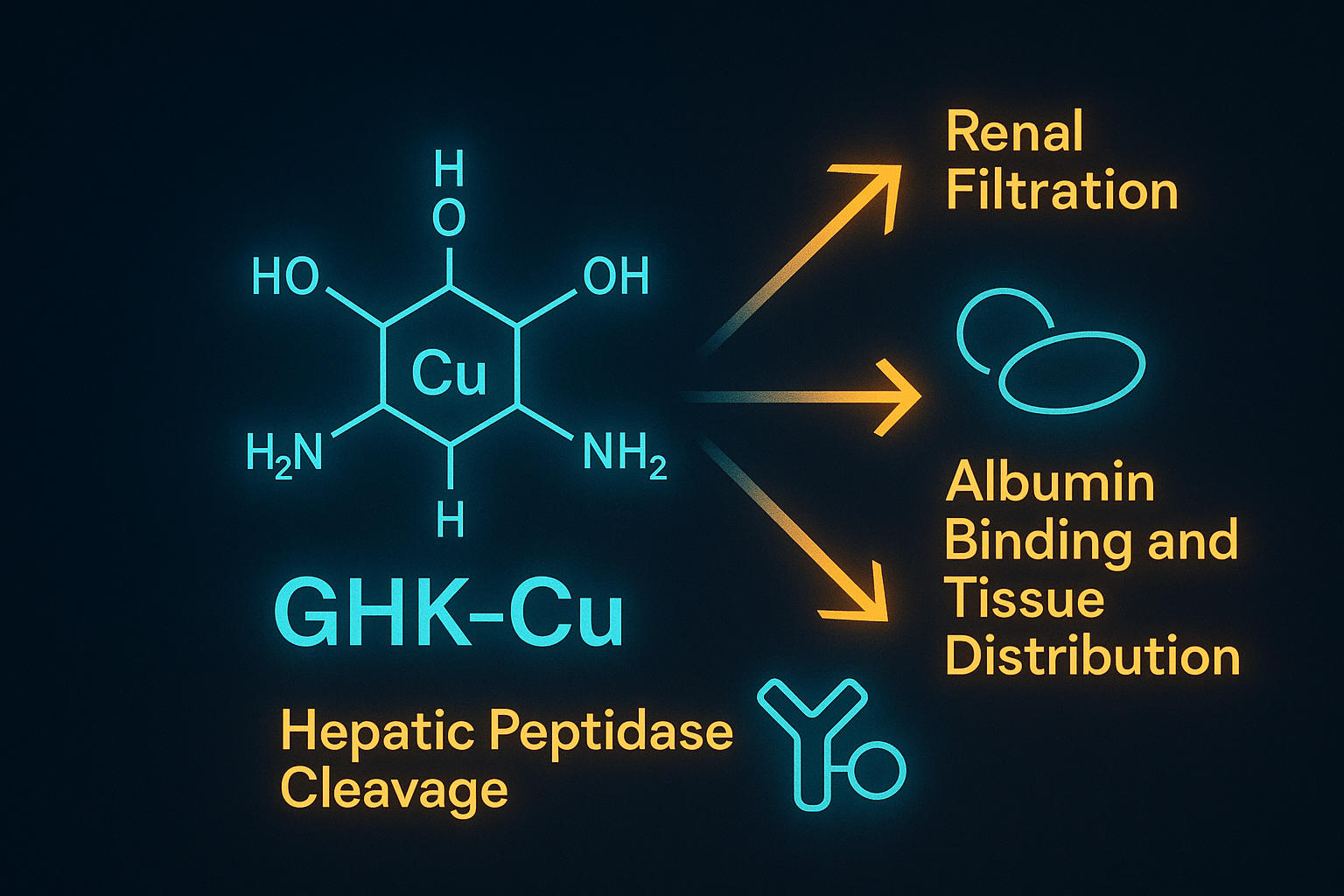
Small compounds don’t have the mass or the structural complexity to resist enzymatic breakdown or renal filtration. A 402-dalton molecule is well below the glomerular filtration cutoff of roughly 60,000 daltons, so once GHK-Cu is in circulation, the kidneys clear whatever isn’t bound to albumin very quickly. This is the reason plasma half-life stays short even though the compound is chemically stable in a vial for years.
Here’s where the vendor blog posts get things wrong. When someone asks about GHK-Cu’s half-life, they might mean one of two very different things.
This is the time it takes for the concentration of GHK-Cu in a research subject’s plasma to drop by half after administration. It’s a property of clearance. how fast the body’s enzymes and organs remove the compound. For GHK-Cu, this is short.
This is the time it takes for the amount of intact GHK-Cu in a container to drop by half through chemical degradation. It’s a property of storage conditions. temperature, moisture, oxygen exposure, pH. For lyophilized GHK-Cu under standard conditions, this is measured in years.
The two numbers describe entirely different processes. A researcher planning a pulsatile in vivo protocol cares about the first number. A laboratory manager planning a procurement and storage cycle cares about the second. Conflating them leads to bad protocol design and wasted inventory.
Pickart’s group has been characterizing GHK-Cu in cell and animal models for nearly five decades. Their 2018 review in Cosmetics pulled together clearance data from earlier work and put the plasma half-life at roughly 30 minutes in preclinical models (Pickart & Margolina, 2018; PMID: 30110429). That number matches what would be predicted for a 402-dalton compound with high albumin affinity. most of it is either bound to serum albumin (which carries it to tissues) or filtered by the kidneys.
Three mechanisms drive rapid clearance. First, the 3-amino-acid compound is small enough to pass freely through the glomerular filtration barrier. anything under about 60 kilodaltons crosses. Second, plasma peptidases can cleave the amide bonds in GHK, though the copper-loaded form appears more resistant to enzymatic breakdown than free GHK.
Third, the compound has high affinity for serum albumin, which acts as both a carrier and a temporary reservoir. some of the compound is released back into circulation as albumin turns over, but most is delivered to tissues where the copper can be transferred to other copper-binding proteins.
Even though the compound clears from plasma in about 30 minutes, the copper ion it delivers doesn’t disappear. Once GHK-Cu docks with a copper-binding partner. ceruloplasmin, metallothionein, or a copper-dependent enzyme. the copper is transferred, and the amino-acid backbone is either recycled or degraded. Downstream biological effects, if any, persist much longer than the compound itself because the metal ion is now part of a different protein.
This is one reason the receptor pharmacology of GHK-Cu is unusual: the compound isn’t binding a single receptor and staying there. It’s acting as a copper shuttle, and once it hands off the copper, its job is done. Pickart’s group has argued in multiple reviews that this shuttle behavior is why GHK-Cu appears to affect so many different pathways at once (Pickart, Vasquez-Soltero, & Margolina, 2015; PMID: 26236094).
Route matters. Intravenous administration in preclinical models produces the fastest peak concentration and the cleanest half-life measurement. Subcutaneous administration slows absorption dramatically. the effective half-life in circulation can appear much longer because the depot at the injection site releases compound over hours. Topical application, common in dermal research protocols, produces localized concentrations that never enter systemic circulation in meaningful amounts (Pickart & Margolina, 2018; PMID: 30110429).
| Route (preclinical) | Approximate plasma half-life | Notes |
|---|---|---|
| Intravenous | ~30 min | Fastest peak; cleanest kinetic measurement |
| Subcutaneous | Effective 2–4 hours | Depot release extends apparent half-life |
| Topical | Local, minimal systemic | Most dermal research uses this route |
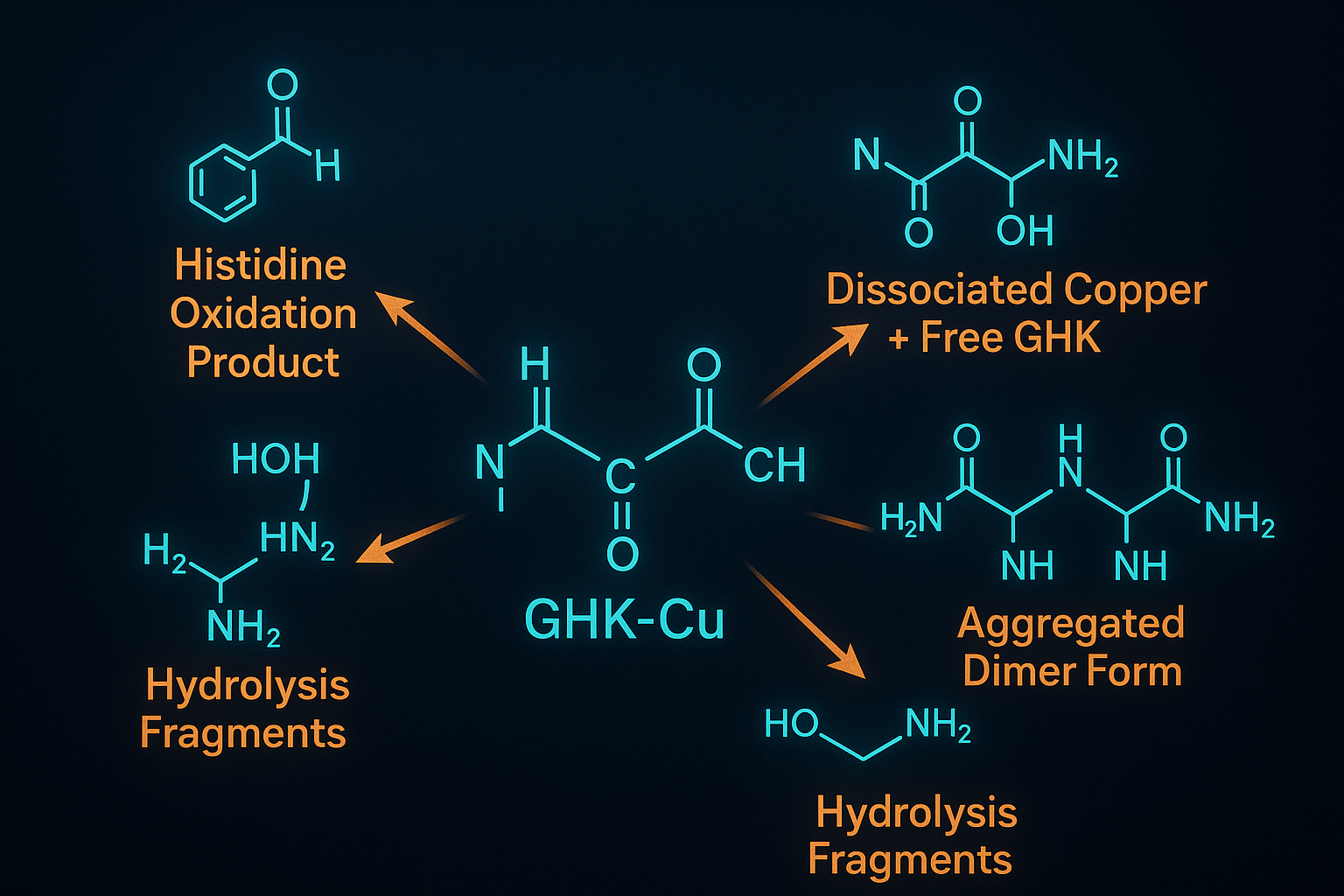
Understanding what breaks GHK-Cu tells you how to store it. Four chemical processes account for essentially all real-world degradation.
The histidine residue in the middle of the GHK sequence is the reactive one. Its imidazole ring can be oxidized under aerobic conditions, especially when reactive oxygen species are present. Copper itself catalyzes some oxidation reactions, which creates a strange feedback loop. the copper that gives the compound its function also accelerates its degradation over long timescales. Oxidized histidine looks nearly identical to intact histidine on standard HPLC methods, so identifying oxidation typically requires mass spectrometry (Reiber, 2008; PMID: 18523691).
The copper is held in place by coordination bonds to the histidine imidazole, the terminal amino group, and the backbone nitrogens. Those bonds depend on the surrounding chemistry. specifically, on the protonation state of the histidine imidazole. Below pH 4, the imidazole picks up a proton and can no longer coordinate copper. The copper falls off, and what’s left is free GHK compound plus a free copper ion.
This isn’t destruction in the strict sense. the amino-acid backbone is intact. but the compound is no longer GHK-Cu, and its behavior in downstream assays will differ.
At high concentrations or in high-ionic-strength solutions, GHK-Cu can precipitate. This is more relevant for concentrated stock solutions than for working dilutions. Warming a precipitated solution can sometimes redissolve the compound, but repeated precipitation-dissolution cycles increase the risk of chemical degradation.
Slow hydrolysis of the amide bonds themselves is possible under prolonged storage in aqueous solution, especially at extremes of pH or temperature. In lyophilized form, without water, this pathway is essentially shut down. This is the main reason freeze-dried compound has a shelf life measured in years while reconstituted solutions have shelf lives measured in weeks.
Lyophilization. freeze-drying under vacuum. is the standard format for research-grade compounds for a specific chemical reason: without water, most degradation pathways slow to a crawl. Hydrolysis stops. Oxidation slows dramatically. Aggregation can’t happen without a solvent.
The reference laboratory storage condition for lyophilized GHK-Cu is −20 °C in a sealed vial, protected from light and moisture. Under these conditions, published stability data and vendor stability studies consistently report shelf lives of 24 months or longer with minimal purity loss (Reiber, 2008; PMID: 18523691).
Some research protocols specify −80 °C for long-term archival storage. The difference between −20 °C and −80 °C for GHK-Cu in a sealed vial is small in practice. both are well below the temperatures at which degradation pathways operate. but −80 °C provides an additional safety margin for laboratories storing compounds for years.
Three things reliably damage lyophilized GHK-Cu.
Laboratories that handle GHK-Cu regularly typically follow a simple protocol: remove the vial from −20 °C, allow it to equilibrate to room temperature before breaking the seal (to prevent condensation on the powder), reconstitute the full contents rather than partial contents, and return unused reconstituted material to 2–8 °C immediately.
Once the compound is dissolved, the clock starts. Water reactivates every degradation pathway that lyophilization suppressed, and stability drops from years to weeks.
Under refrigeration (2–8 °C), reconstituted GHK-Cu in bacteriostatic water is generally considered stable for 4–6 weeks with minimal loss of intact compound by HPLC. At room temperature, that window collapses to a few days. Above 30 °C, degradation is measurable within hours (Reiber, 2008; PMID: 18523691).
| Storage condition | Approximate stability window | Dominant degradation pathway |
|---|---|---|
| Lyophilized, −20 °C, sealed, dark | 24+ months | Trace oxidation (very slow) |
| Lyophilized, −80 °C, sealed, dark | 36+ months | Essentially none measurable |
| Reconstituted, 2–8 °C, bacteriostatic water | 4–6 weeks | Slow hydrolysis + oxidation |
| Reconstituted, room temperature | 3–7 days | Oxidation, hydrolysis |
| Reconstituted, >30 °C | Hours | Rapid oxidation, aggregation |
Reconstituted GHK-Cu can be aliquoted and frozen for longer-term storage of ready-to-use working solutions, but repeated freeze-thaw cycles introduce their own stress. Each freeze creates ice crystals that concentrate the compound in the remaining liquid phase and can drive aggregation. Each thaw reactivates degradation. Research protocols that require frozen working aliquots typically freeze once, thaw once, and discard rather than refreeze.
The choice of diluent isn’t cosmetic. It shapes both the pH of the final solution and the stability profile over the weeks of use.
Bacteriostatic water. sterile water containing 0.9% benzyl alcohol as a preservative. is the standard research diluent for lyophilized compounds. The benzyl alcohol prevents microbial growth over the multi-week storage window a reconstituted solution typically sees. The pH is near neutral, which keeps the copper coordinated to the compound.
Plain sterile water works for short-term studies where the entire reconstituted volume will be used within days. It lacks the preservative, so extended storage risks microbial contamination.
Saline is generally avoided for GHK-Cu reconstitution. The chloride ions can compete with the compound for copper coordination and shift the equilibrium away from the intact GHK-Cu complex over time. For short exposure. dilution just before use. saline is acceptable. For storage, it’s not the right choice.
GHK-Cu is most stable in the pH range 6.5–8. Below 4, copper dissociates. Above 9, hydroxide ions can compete for the copper coordination site and drive alternative complex formation. The bacteriostatic-water starting point of pH ~7 sits comfortably in the stable range.
The practical storage protocol for a research inventory pulls together the chemistry above into a small number of clear steps.
For studies that draw from the same stock repeatedly over weeks, some laboratories prepare single-use aliquots at the time of first reconstitution, freeze them at −20 °C, and thaw individual aliquots as needed. This avoids the repeated seal-breaking of a shared stock vial and reduces cumulative oxidation exposure. The trade-off is that each freeze-thaw cycle introduces its own stress; the aliquot approach works best when it’s a single freeze followed by a single thaw.
Stability data on a page is only useful if the lot in front of you actually matches. That’s where analytical verification comes in.
Reverse-phase HPLC with UV detection is the standard method for measuring compound purity. A pure GHK-Cu reference standard should elute as a single dominant peak with purity ≥98% by area. Small side peaks may represent oxidized variants, free compound (copper-dissociated), or synthesis-related impurities.
Vitro Labs tests every lot to identity and purity by HPLC-UV through Freedom Diagnostics, an ISO-certified independent analytical laboratory. The batch-specific certificate of analysis reports purity, identity, net content, appearance, and the method used.
Mass spectrometry confirms that the peak at the expected retention time is actually GHK-Cu and not a co-eluting impurity. The expected monoisotopic mass for the copper-loaded 3-amino-acid compound, accounting for the standard salt form, sits in a narrow window that mass spectrometry resolves cleanly. Identity verification is what separates a real reference standard from a peak of unknown composition.
The Vitro Labs certificate of analysis reports identity (LC-MS), purity (HPLC-UV), net content, appearance, and the analytical method. That’s the complete list. Sterility, endotoxin, and heavy-metal analyses are not part of our certificate. those tests are outside our scope, and readers evaluating a certificate should check what any laboratory actually reports rather than what they assume it reports.
Placing GHK-Cu’s stability profile alongside other short compounds helps calibrate expectations.
AHK-Cu is structurally related. alanine replaces glycine at the N-terminus. Its stability profile is broadly similar. The alanine substitution slightly changes the coordination geometry around copper and shifts the compound’s biological targeting compared to GHK-Cu, but degradation pathways (histidine oxidation, copper dissociation at low pH) are the same.
BPC-157 is a 15-amino-acid compound (15-amino-acid compound). much larger than GHK-Cu and without a coordinated metal. Its degradation profile is dominated by amide bond hydrolysis rather than oxidation, and it has no pH-dependent metal dissociation pathway to worry about. Lyophilized shelf life is comparable; reconstituted stability is generally longer for BPC-157 because it lacks the histidine oxidation vulnerability.
TB-500 is a 17-mer with different chemistry again. Its stability challenges center on the acetylated N-terminus and specific residue oxidations rather than metal coordination. Different compound, different failure modes, but the same general principle: lyophilized storage extends shelf life dramatically over reconstituted storage.
What GHK-Cu shares with all of these is the fundamental dependence on temperature and moisture control. What sets it apart is the additional copper dissociation pathway. a stability variable no other common research-grade compound has to manage.
⚗️ Research Disclaimer: All content on this page is intended exclusively for licensed researchers, academic institutions, and scientific professionals operating within approved laboratory settings. GHK-Cu is a research compound not approved for human clinical use by the FDA or equivalent regulatory authorities. This content does not constitute medical advice, clinical guidance, or a recommendation for use in humans or animals outside of approved research protocols.
Products are supplied as analytical-grade biochemical reference standards for laboratory research use only and are not for human or animal consumption.
Recent literature has continued to expand what’s known about GHK-Cu at the cellular signaling level, including copper delivery to specific enzyme targets and downstream gene expression effects. Pickart’s group has continued publishing on the compound’s role as a copper shuttle and its interactions with cellular repair pathways, most recently in a series of reviews consolidating four decades of preclinical findings (Pickart, Vasquez-Soltero, & Margolina, 2015; PMID: 26236094).
What hasn’t changed in the recent literature: the practical stability parameters. The 30-minute plasma half-life, the 24+ month lyophilized shelf life, the 4–6 week reconstituted stability window. these are consistent across the last decade of published work. Storage chemistry doesn’t move fast. What moves is the mechanistic understanding of what the compound does downstream once the copper is delivered.
GHK-Cu is supplied strictly as an analytical-grade biochemical reference standard for in-vitro research, analytical method development, identity verification, and laboratory evaluation by qualified research customers. It is not approved by the FDA for human clinical use, and materials sold for research use are not intended for consumption, therapeutic use, clinical use, diagnostic use, dietary supplementation, dosing, injection, ingestion, or administration.
For research inventories, three things matter when selecting a supplier: independent third-party purity and identity testing, batch-specific documentation, and traceable lot numbers. Vitro Labs supplies GHK-Cu 50mg as a lyophilized reference standard with a batch-specific certificate of analysis from Freedom Diagnostics on every order. See the Certificates of Analysis page for representative documentation and the Editorial Standards page for our sourcing and testing framework.
In preclinical models, the plasma half-life of GHK-Cu is approximately 30 minutes after intravenous administration (Pickart & Margolina, 2018; PMID: 30110429). The short half-life reflects the compound’s small molecular weight (~402 daltons), which allows rapid renal filtration, along with high affinity for serum albumin, which shuttles the compound to tissues. Route of administration affects the apparent half-life. subcutaneous administration extends the effective circulating time through depot release at the injection site, while topical application produces localized rather than systemic exposure.
Lyophilized GHK-Cu stored at −20 °C in a sealed vial, protected from light and moisture, is generally reported to be stable for 24 months or longer with minimal purity loss by HPLC. Storage at −80 °C extends the stability window further and is preferred for long-term archival research inventories. The key preservation variables are temperature control, moisture exclusion, and light protection. Once reconstituted, the stability window drops to weeks at refrigerated temperatures and days at room temperature (Reiber, 2008; PMID: 18523691).
Plasma half-life describes how quickly the compound is cleared from a research subject’s circulation after administration. approximately 30 minutes for GHK-Cu, driven by renal filtration and enzymatic clearance. Shelf life describes how long the compound remains chemically intact in a storage vial, which is measured in years for lyophilized material under proper conditions. The two numbers describe entirely different processes: pharmacokinetic clearance in solution vs. chemical stability in the absence of water and metabolic enzymes. Conflating them leads to confusion in protocol planning and inventory management.
Four chemical processes account for essentially all GHK-Cu degradation in laboratory settings: oxidation at the histidine residue (particularly under aerobic conditions and light exposure), copper dissociation from the compound at pH below 4, aggregation and precipitation in high-concentration or high-ionic-strength solutions, and slow amide bond hydrolysis over prolonged aqueous storage. Lyophilization suppresses hydrolysis and slows the other pathways dramatically by removing water. Reconstitution reactivates all four (Reiber, 2008; PMID: 18523691).
Bacteriostatic water. sterile water containing 0.9% benzyl alcohol. is the standard research diluent for GHK-Cu reconstitution. The benzyl alcohol acts as a preservative over the multi-week reconstituted stability window, and the near-neutral pH keeps copper coordinated to the compound. Sterile water for injection is acceptable for short-term studies where the reconstituted material will be used within days but lacks the preservative for extended storage. Saline (0.9% sodium chloride) is generally avoided because chloride ions can compete with the compound for copper coordination over time.
Purity is measured by reverse-phase HPLC with UV detection (HPLC-UV), where a pure GHK-Cu reference standard elutes as a single dominant peak at ≥98% purity by area. Identity is confirmed by liquid chromatography-mass spectrometry (LC-MS), which measures the exact mass of the eluted peak to verify it matches the expected molecular weight of the copper-loaded 3-amino-acid compound. Purity and identity are complementary. HPLC-UV answers how much of one thing is present, while LC-MS answers what that thing is. Both are reported on batch-specific certificates of analysis for research-grade material.
⚗️ Research Disclaimer: All content on this page is intended exclusively for licensed researchers, academic institutions, and scientific professionals operating within approved laboratory settings. GHK-Cu is a research compound not approved for human clinical use by the FDA or equivalent regulatory authorities. This content does not constitute medical advice, clinical guidance, or a recommendation for use in humans or animals outside of approved research protocols.