
This article is provided for educational and informational purposes only. All compounds discussed are supplied strictly for laboratory and research use. Vitro Labs products are not for human or animal consumption.
This article is provided for educational and informational purposes only. All compounds discussed are supplied strictly for laboratory and research use. Vitro Labs products are not for human or animal consumption.
The GLP receptor pathway is one of the most actively studied signaling families in compound research right now. And it is not hard to see why.
Between 2018 and 2023, peer-reviewed papers in The Lancet and The New England Journal of Medicine showed what happens when synthetic compounds engage one, two, or even three incretin-related receptors at once (Frias et al., 2018, PMID: 30293770; Jastreboff et al., 2023, PMID: 37351564). Each new receptor added to the equation changed the signaling profile in ways that caught the research community’s attention.
This roundup walks through the GLP receptor pathway family, the compounds researchers use to probe it, and the published evidence behind each approach. All content is for laboratory research use only.
The short version: the GLP receptor pathway is a signaling system built around a family of hormones the gut releases after eating. These hormones bind to specific receptors on cells throughout the body, triggering cascades that affect insulin release, glucose handling, and a range of metabolic processes.
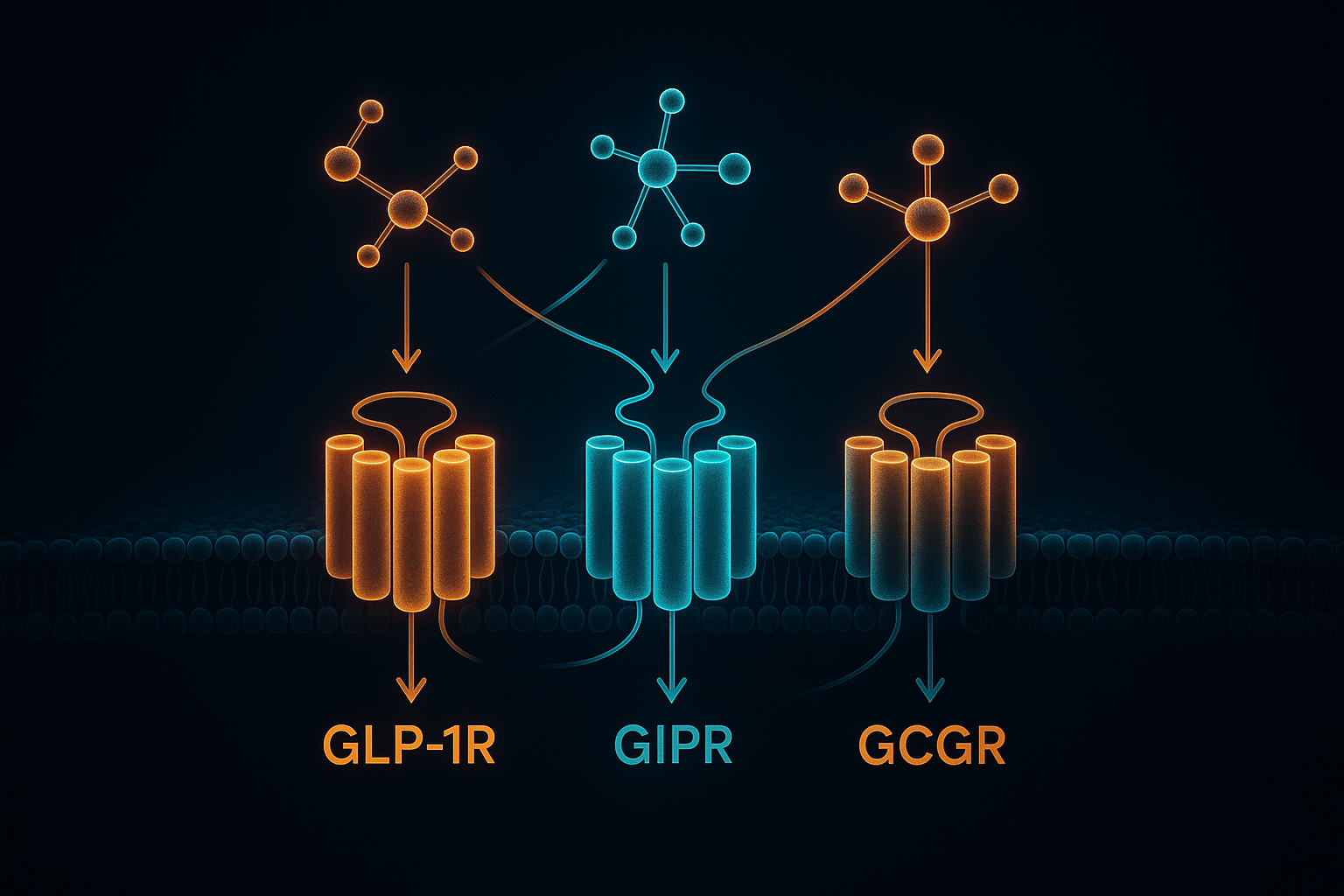
The pathway centers on three key receptors. Each one responds to a different gut-derived hormone, and each triggers its own downstream signaling chain. Understanding the differences between these receptors is the foundation of modern incretin pathway research.
Three receptors define the GLP family:
Holst (2007) published what remains one of the definitive reviews of GLP-1 physiology in Physiological Reviews, mapping the receptor’s distribution, signaling, and role in preclinical metabolic models (PMID: 17928583). That paper set the stage for two decades of incretin-pathway research.
Campbell and Drucker (2013) expanded the picture to include both GLP-1 and GIP receptor pharmacology in a Cell Metabolism review. Their key point: the two incretin receptors do not simply duplicate each other’s effects. They engage overlapping but distinct signaling cascades (PMID: 23823483).
Most GLP pathway research starts here. The GLP-1 receptor was the first of the three to be characterized in detail. It is the one that every single-, dual-, and triple-agonist compound in this roundup engages.
GLP-1R is a class B G-protein-coupled receptor (GPCR). When GLP-1 binds, it activates a G-protein on the inside of the cell. That triggers adenylyl cyclase to produce cyclic AMP (cAMP). From there, the signaling branches out through PKA and Epac pathways.
Drucker (2018) mapped these downstream events in a comprehensive Cell Metabolism review. The key finding: GLP-1R activation does not just affect insulin secretion. It also influences glucagon suppression, gastric motility, and signaling in hypothalamic neurons (PMID: 29719226).
That multi-tissue reach is part of what makes the GLP-1 receptor so interesting to researchers. It is not a one-function switch. It is a hub that connects to multiple systems at once.
The first generation of synthetic GLP-1 pathway compounds targeted one receptor: GLP-1R. These single-agonist compounds gave researchers their initial tools for probing the pathway’s biology in controlled in vitro and in vivo models.
Semaglutide and liraglutide are the two most widely referenced single-agonist GLP-1 compounds in the literature. Both are acylated analogs of native GLP-1, engineered for extended half-life through albumin binding.
Nauck and Meier (2018) reviewed the incretin hormone family’s pharmacology in Diabetes, Obesity and Metabolism. They noted that single-agonist GLP-1R targeting produces measurable effects on insulin secretion and glucagon suppression in preclinical and research models (PMID: 29364588). But the review also highlighted a limitation.
Single-receptor targeting leaves the GIP and glucagon receptor pathways untouched. Researchers studying broader metabolic signaling found that GLP-1R agonism alone did not capture the full scope of incretin biology. That gap is what drove the development of multi-receptor compounds.
Vitro Labs does not carry standalone semaglutide or liraglutide. For researchers focused on multi-agonist GLP pathway compounds, Vitro’s catalog includes the dual-agonist tirzepatide and triple-agonist retatrutide as verified reference standards.
The dual-agonist concept asks a simple question: what happens when a single compound activates both GLP-1R and GIPR at once? The answer turned out to be more interesting than most researchers expected.
Tirzepatide is a 39-amino-acid synthetic compound built on a GIP-based backbone with engineered GLP-1R activity. It is not simply a blend of two single-agonist molecules. It is one molecule designed to bind both receptors, though with different affinities at each.
Willard et al. (2020) published a detailed receptor pharmacology study in JCI Insight that characterized exactly how tirzepatide interacts with both targets. Their finding: tirzepatide is an “imbalanced and biased” dual agonist. It activates GIPR more strongly than GLP-1R, and it triggers a different signaling bias at GLP-1R compared to native GLP-1 (PMID: 32730226).
That imbalance matters. It means tirzepatide does not just double the GLP-1 signal. It creates a fundamentally different signaling profile than either receptor would produce alone.
The landmark dual-agonist dataset came from Frias and colleagues at Eli Lilly. Their 2018 Lancet paper reported results from a randomized, placebo-controlled phase 2 trial studying tirzepatide (then LY3298176) across multiple metabolic endpoints (PMID: 30293770).
The study documented dose-dependent changes in metabolic endpoints that exceeded the single-agonist comparator arm. Frias et al. attributed the enhanced response to the dual-receptor mechanism, though they noted the need for larger confirmatory studies.
For a deeper look at tirzepatide pharmacokinetics in preclinical research models, Vitro’s Research Library covers half-life, stability, and handling in detail.
⚗️ Research Disclaimer: All content on this page is intended exclusively for licensed researchers, academic institutions, and scientific professionals operating within approved laboratory settings. The compounds discussed are research compounds not approved for human clinical use by the FDA or equivalent regulatory authorities. This content does not constitute medical advice, clinical guidance, or a recommendation for use in humans or animals outside of approved research protocols.
If dual agonism changes the signaling equation, triple agonism changes it again. Adding the glucagon receptor (GCGR) to the mix introduces a third axis: hepatic glucose output and energy expenditure pathways that neither GLP-1R nor GIPR engagement alone can access.
Retatrutide is a synthetic compound engineered to activate GLP-1R, GIPR, and GCGR simultaneously. The structural design is more complex than tirzepatide’s. Retatrutide must balance activity across three receptors with different binding pockets and different downstream signaling preferences.
The rationale for adding glucagon receptor agonism seems counterintuitive at first. Glucagon raises blood glucose. Why would researchers want to activate a glucose-raising pathway alongside two glucose-lowering ones?
The answer lies in glucagon’s other roles. GCGR activation also stimulates hepatic lipid oxidation, increases energy expenditure, and engages thermogenic pathways in preclinical models. Those effects add a metabolic dimension that dual agonism does not capture.
Jastreboff and colleagues published the first major triple-agonist dataset in The New England Journal of Medicine in 2023. Their phase 2 trial documented retatrutide’s effects across multiple dose levels, reporting dose-dependent changes in metabolic endpoints that exceeded previously published dual-agonist data (PMID: 37351564).
The study used a randomized, double-blind, placebo-controlled design with active comparator arms. Researchers measuring GLP pathway signaling have cited it extensively as evidence that triple-receptor engagement produces a signaling profile distinct from either single or dual agonism.
For a detailed comparison of the dual and triple agonist approaches, see the Tirzepatide vs Retatrutide mechanism and research comparison.
The table below summarizes the three agonist approaches side by side. Each row compares a key research parameter across single-agonist, dual-agonist, and triple-agonist compounds studied in GLP pathway research.
| Parameter | Single Agonist (GLP-1R) | Dual Agonist (GLP-1R + GIPR) | Triple Agonist (GLP-1R + GIPR + GCGR) |
|---|---|---|---|
| Example compound | Semaglutide, Liraglutide | Tirzepatide | Retatrutide |
| Receptors targeted | GLP-1R only | GLP-1R + GIPR | GLP-1R + GIPR + GCGR |
| Structural class | GLP-1 analog (acylated) | GIP-based backbone with GLP-1R activity | Engineered tri-agonist compound |
| Landmark study | Nauck and Meier (2018) | Frias et al. (2018), The Lancet | Jastreboff et al. (2023), NEJM |
| GIP receptor engagement | None | Strong (primary backbone) | Yes |
| Glucagon receptor engagement | None | None | Yes |
| Research status | Extensively studied since the 1990s | Phase 2-3 data published | Phase 2 data published (2023) |
For a head-to-head breakdown of single vs. dual agonism, the Tirzepatide vs Semaglutide comparison covers the mechanistic differences in depth.
The published literature on GLP receptor pathway compounds has grown dramatically since the early 2000s. Three studies anchor the research base for anyone investigating this pathway at the preclinical or reference-standard level.
Jens Juul Holst’s 2007 review in Physiological Reviews remains one of the most-cited papers on GLP-1 physiology. It mapped the receptor’s tissue distribution, characterized the cAMP/PKA signaling cascade triggered by GLP-1R activation, and documented the hormone’s rapid enzymatic degradation by DPP-4 (PMID: 17928583).
Holst’s work established the pharmacological rationale for synthetic GLP-1 analogs. Native GLP-1 has a half-life of about two minutes in circulation. Every synthetic GLP-1R agonist since has been engineered to resist DPP-4 cleavage and extend that window.
Juan Pablo Frias and colleagues at Eli Lilly published the first randomized, controlled dual-agonist trial in The Lancet. They tested four dose levels of tirzepatide (then LY3298176) against placebo and a GLP-1R-only comparator in a 26-week study (PMID: 30293770).
The findings showed dose-dependent changes in metabolic endpoints that exceeded the single-agonist comparator arm. Frias et al. attributed the enhanced response to concurrent GLP-1R and GIPR activation and noted the need for larger confirmatory studies.
Ania Jastreboff and colleagues took the next step: adding glucagon receptor agonism to the equation. Their phase 2 trial, published in The New England Journal of Medicine, tested retatrutide across multiple dose arms in a 48-week study (PMID: 37351564).
The results documented that triple-receptor engagement produced metabolic changes that were quantitatively different from both single- and dual-agonist published datasets. The study positioned retatrutide as a distinct research tool rather than an incremental modification of the dual-agonist approach.
Regardless of how many receptors a compound targets, the quality of the reference standard matters. A poorly characterized compound produces unreliable data. In GLP pathway research, where investigators often compare results across agonist classes, inconsistent purity can confound every downstream measurement.
For GLP pathway compounds specifically, identity verification confirms that the material is the intended amino-acid sequence, not a degraded fragment or a different molecule entirely. HPLC separates the sample by molecular properties and reports a purity percentage. Mass spectrometry confirms the molecular weight matches the expected compound.
Both tests appear on batch-specific Certificates of Analysis from qualified independent laboratories. Vitro Labs ships every batch with a COA from Freedom Diagnostics, an ISO-certified analytical lab in Franklin, TN. Identity (LC-MS), purity (HPLC-UV), net content, and appearance are verified per batch.
Researchers evaluating GLP pathway compounds from any supplier should verify that the COA is batch-specific (not a generic template), issued by a named independent lab (not the manufacturer itself), and reports both identity and purity with methodology clearly stated. The Vitro Editorial Standards page documents the citation and quality standards applied across the Research Library.
GLP receptor pathway research is moving faster in 2025-2026 than at any point in the pathway’s history. Several directions are worth tracking.
First, the multi-agonist trend is continuing. Researchers are asking whether compounds engaging four or more receptor targets could produce even more distinct signaling profiles. Early preclinical work is exploring combinations that add amylin, cholecystokinin (CCK), or PYY receptor engagement on top of the existing GLP/GIP/glucagon base.
Second, the biased agonism question is getting more attention. Willard et al. (2020) showed that tirzepatide does not activate GLP-1R the same way native GLP-1 does. It triggers a different signaling bias at the receptor level (PMID: 32730226). Researchers are now asking whether similar biased agonism exists at GIPR and GCGR, and whether that bias matters for downstream signaling in different tissue types.
Third, the reference-standard quality question is becoming more urgent as these compounds proliferate. The more structurally complex a compound is, the more failure modes exist during synthesis. Triple-agonist compounds like retatrutide present more analytical challenges than simpler single-agonist compounds, making batch-specific independent verification critical for research reproducibility.
Researchers can explore the complete Vitro Research Library for compound-specific deep-dives, comparisons, and handling guides across the GLP pathway and beyond. All reference standards are available through the Vitro catalog with batch-specific COAs from Freedom Diagnostics, for laboratory research use only.
⚠️ Research Disclaimer: This article is for educational and informational purposes only. All compounds discussed are research chemicals for laboratory use only and are not for human consumption.
The GLP receptor pathway centers on three G-protein-coupled receptors: GLP-1R (glucagon-like compound-1 receptor), GIPR (glucose-dependent insulinotropic polycompound receptor), and GCGR (glucagon receptor). Each responds to a different gut-derived or pancreatic hormone and triggers distinct downstream signaling cascades. Holst (2007) mapped the GLP-1R pathway in detail in Physiological Reviews (PMID: 17928583). All three receptors are studied in preclinical and in vitro research models. These compounds are for laboratory research use only.
Single agonism targets GLP-1R only (examples: semaglutide, liraglutide). Dual agonism engages both GLP-1R and GIPR simultaneously (example: tirzepatide). Triple agonism adds GCGR to the mix, activating all three incretin-related receptors at once (example: retatrutide). Each approach produces a different signaling profile in preclinical research models. Frias et al. (2018) documented dual-agonist research findings in The Lancet (PMID: 30293770), while Jastreboff et al. (2023) published triple-agonist data in The New England Journal of Medicine (PMID: 37351564).
Semaglutide is a single GLP-1R agonist built on a GLP-1 analog backbone. Tirzepatide is a dual agonist that engages both GLP-1R and GIPR, built on a GIP-based backbone with engineered GLP-1R activity. Willard et al. (2020) showed in JCI Insight that tirzepatide is an imbalanced and biased dual agonist, meaning it activates each receptor with different potency and triggers different intracellular signaling pathways compared to native hormone binding (PMID: 32730226). Both compounds are studied in preclinical research models only.
Jastreboff and colleagues published a phase 2 trial in The New England Journal of Medicine testing retatrutide, a triple GLP-1R/GIPR/GCGR agonist, across multiple dose arms over 48 weeks. The study reported dose-dependent changes in metabolic endpoints that were quantitatively different from previously published single- and dual-agonist datasets (PMID: 37351564). The results positioned retatrutide as a distinct research tool for studying the combined effects of all three incretin-related receptors.
Identity is typically confirmed by liquid chromatography-mass spectrometry (LC-MS), which verifies the compound molecular weight matches the expected sequence. Purity is measured by HPLC-UV, which separates the sample to quantify how much of the total material is the intended compound versus degradation products or impurities. Vitro Labs ships every batch with a Certificate of Analysis from Freedom Diagnostics, an ISO-certified independent analytical laboratory, reporting identity, purity, net content, and appearance. All compounds are for laboratory research use only.
⚗️ Research Disclaimer: All content on this page is intended exclusively for licensed researchers, academic institutions, and scientific professionals operating within approved laboratory settings. The compounds discussed are research compounds not approved for human clinical use by the FDA or equivalent regulatory authorities. This content does not constitute medical advice, clinical guidance, or a recommendation for use in humans or animals outside of approved research protocols.