
This article is provided for educational and informational purposes only. All compounds discussed are supplied strictly for laboratory and research use. Vitro Labs products are not for human or animal consumption.
GHK-Cu is one of the most peculiar molecules in compound research. It is a tiny copper-carrying 3-amino-acid compound. just three amino acids (glycyl-L-histidyl-L-lysine) wrapped around a single copper ion. and yet decades of preclinical work suggest it does an outsized amount of work inside skin tissue. Loren Pickart first isolated the sequence from human plasma in 1973, and the story since has been a slow accumulation of evidence that this small complex nudges fibroblasts to build collagen, remodel the extracellular matrix, and behave more like they did when the donor was younger.
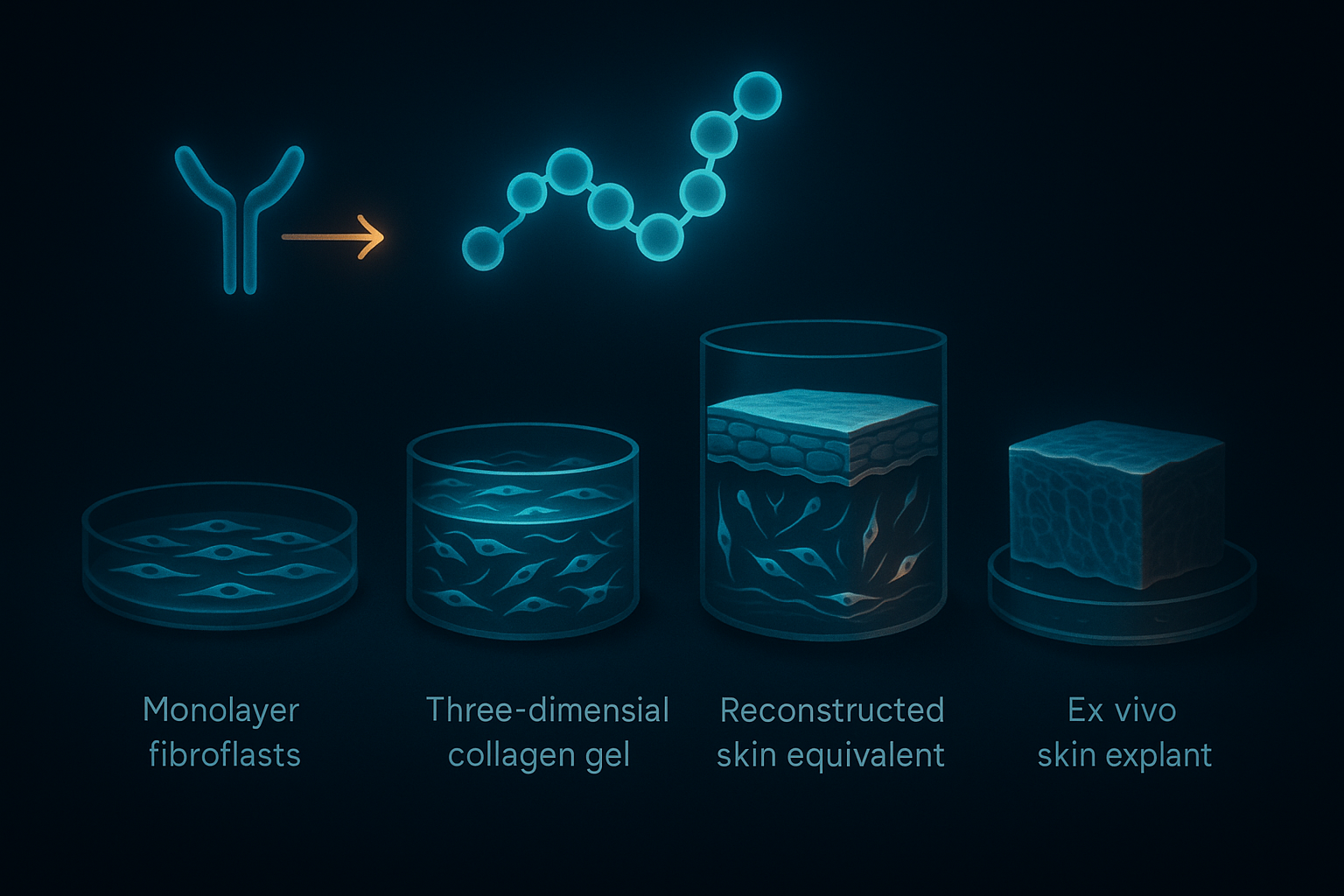
Most of what researchers know about GHK-Cu and collagen synthesis comes from dermal matrix models. cultured human skin fibroblasts, three-dimensional collagen gels, ex vivo skin explants, and reconstructed dermal equivalents. These systems let scientists watch collagen production in real time without any of the confounds of a whole organism.
This reference reviews what those models have shown, how the copper-compound complex actually engages fibroblast signaling, where the strongest evidence sits versus where the field is still speculating, and how laboratories handle GHK-Cu reference standards for reproducible work. for laboratory research use only.
Before walking through the mechanism in detail, here is what preclinical research has established about GHK-Cu in dermal matrix systems, with the primary citations that anchor each claim:
GHK is a 3-amino-acid compound: glycyl-L-histidyl-L-lysine. Three amino acids in sequence, small enough that its molecular weight sits at about 340 daltons for the free compound. Add a copper(II) ion and the mass climbs to roughly 402 daltons for the 1:1 complex. That copper ion is the whole point.
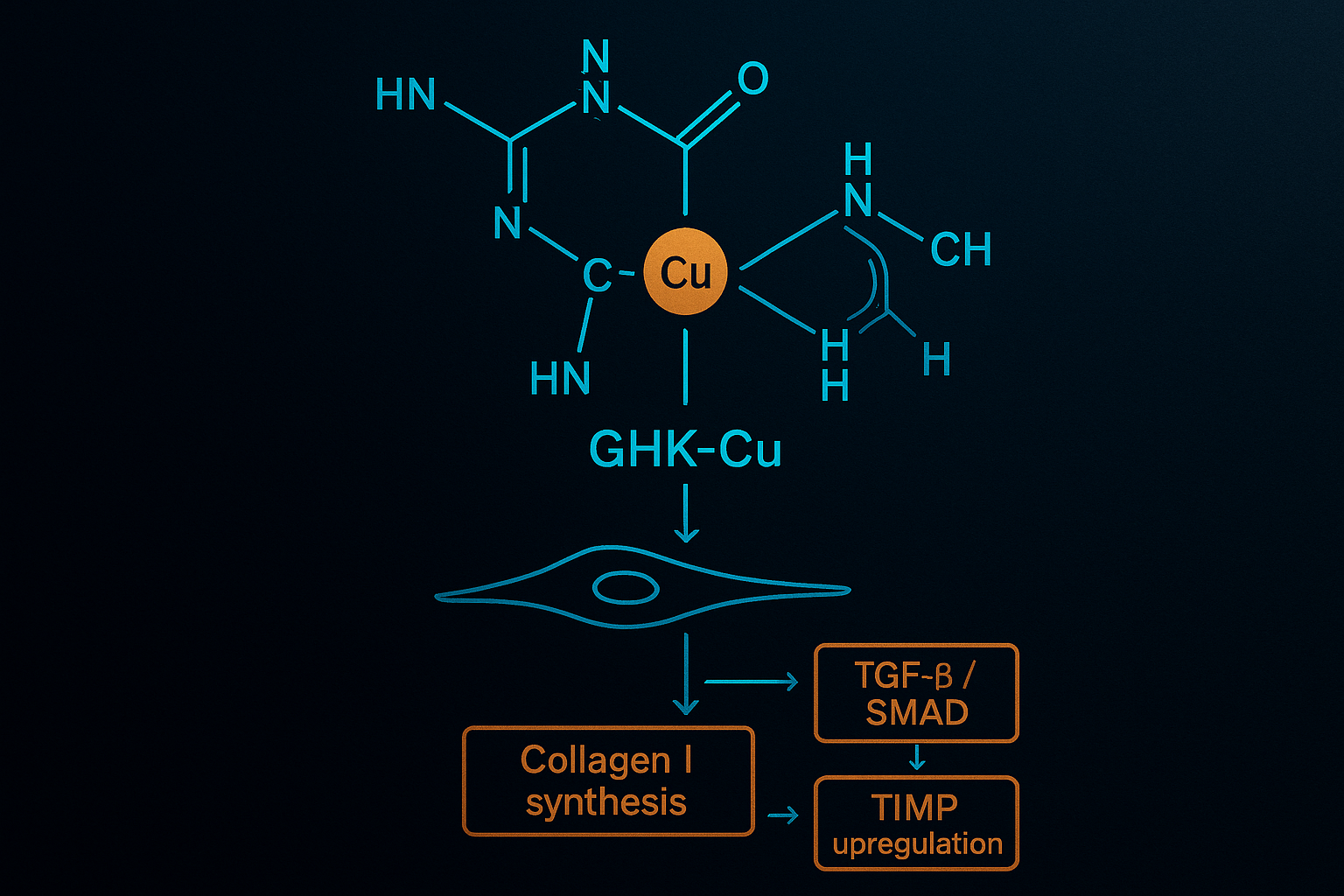
Freedman and colleagues resolved the coordination geometry in 1982 (PMID: 7052113) and showed that the copper sits in a square-planar arrangement. bound by the imidazole nitrogen of the histidine, the terminal amino nitrogen, and the deprotonated amide nitrogen of the glycyl-histidyl bond. The lysine side chain sticks out into solution and gives the complex much of its physical behavior.
Two things follow from this geometry. First, the affinity of GHK for copper is remarkably high. high enough that GHK in serum will pull copper off of albumin, the main copper carrier in blood. Second, the copper is not just along for the ride. It is doing chemistry.
Copper is a redox-active metal, and much of what the GHK-Cu complex does at the cellular level appears to involve copper’s ability to shuttle electrons, participate in enzymatic reactions, and interact with copper-dependent proteins inside cells.
Pickart originally isolated GHK from human plasma during work on why old plasma differed from young plasma in its effects on cultured liver cells (Pickart and Thaler, 1973). The 3-amino-acid compound sequence turns up as a natural fragment of larger proteins. most notably from a segment of the alpha-2 chain of type I collagen. and its plasma concentration declines with age.
That age-related decline is one of the reasons the compound has captured so much research attention. If the young-plasma phenotype involves GHK, and GHK falls with age, then adding GHK back to older tissue is an obvious experiment to run.
The literature uses several names interchangeably: GHK for the compound alone, GHK-Cu or Cu-GHK for the copper complex, and occasionally “copper complex-1” in cosmetic-industry papers. In dermal matrix research, the copper-loaded form is almost always what is being tested. the metal is central to activity.
Human skin is a layered organ with a lot of moving parts. If a researcher wants to isolate what happens to fibroblasts when they see GHK-Cu, they need a system where fibroblasts are the main variable. Dermal matrix models solve that problem by simplifying skin down to the components that matter for collagen research.
The classical GHK-Cu papers from the 1980s used monolayer cultures of human dermal fibroblasts. cells grown in a single flat layer on plastic. Simple, reproducible, and enough to measure collagen output using radiolabeled proline incorporation. Later work moved into three-dimensional systems: fibroblasts embedded inside a hydrated collagen gel that they can remodel, contract, and rebuild.
These models capture something a flat cell layer cannot. the mechanical feedback loop where fibroblasts respond to the stiffness and organization of the matrix they are sitting in.
The most tissue-like preclinical models are reconstructed skin equivalents and ex vivo human skin explants. Reconstructed skin equivalents stack a keratinocyte layer on top of a fibroblast-populated dermal compartment, which lets researchers ask whether epidermal-dermal signaling changes the fibroblast response to GHK-Cu. Ex vivo explants are pieces of donated human skin maintained in culture for a few days. They are the closest thing to actual skin without being in a living person.
Here is the basic story that Maquart’s group and others assembled through the late 1980s and 1990s. When cultured dermal fibroblasts encounter GHK-Cu at nanomolar concentrations, they increase their output of type I collagen. the main structural collagen of skin dermis. They also increase production of other matrix components including glycosaminoglycans and elastin precursors.
The effect is dose-responsive up to a point, then plateaus, and at high micromolar concentrations reverses (a common pattern for signaling molecules that engage multiple pathways with different affinities).
One of the more compelling mechanistic threads runs through TGF-β signaling. TGF-β is the master regulator of matrix production in dermal fibroblasts. When TGF-β binds its receptor, it triggers the SMAD signaling cascade, which drives transcription of collagen genes and matrix-modulating enzymes. Several studies have observed that GHK-Cu treatment increases TGF-β expression in dermal fibroblasts and modulates downstream SMAD activity (McCormack et al., 2001, PMID: 11250050).
The details of how the copper-compound complex actually engages this pathway remain incompletely resolved. whether it acts through a specific receptor, through modulation of copper-dependent enzymes upstream of TGF-β, or through some combination.
Collagen synthesis is only half of the story. Skin is constantly turning over its matrix. building new collagen while breaking old collagen down. The breakdown side is handled by matrix metalloproteinases (MMPs), and their activity is restrained by tissue inhibitors of metalloproteinases (TIMPs). If the MMP/TIMP balance tilts toward degradation, skin ages structurally.
Simeon and colleagues reported that GHK-Cu shifts this balance in cultured fibroblasts, upregulating TIMP-1 and TIMP-2 expression while modulating MMP activity (Simeon et al., 1999, PMID: 10084307). The net effect in these preclinical systems is a matrix environment that favors accumulation over breakdown.
Copper is not decorative here. Several copper-dependent enzymes are directly relevant to matrix biology. Lysyl oxidase is a copper-dependent enzyme that cross-links collagen and elastin, and it depends on adequate copper availability to function. Superoxide dismutase. one of the main cellular antioxidants. is also copper-dependent. When GHK delivers copper to cells, it may support the function of these enzymes in ways that free copper (which is toxic) cannot achieve safely.
The copper delivery hypothesis is one of the more elegant explanations for why the metal-compound complex behaves so differently from either component alone.
⚗️ Research Disclaimer: All content on this page is intended exclusively for licensed researchers, academic institutions, and scientific professionals operating within approved laboratory settings. GHK-Cu is a research compound not approved for human clinical use by the FDA or equivalent regulatory authorities. This content does not constitute medical advice, clinical guidance, or a recommendation for use in humans or animals outside of approved research protocols.
Loren Pickart was working on hepatocyte aging in the early 1970s when he noticed that plasma from young donors made old rat liver cells behave more like young cells. He fractionated the plasma looking for the active factor and eventually isolated a 3-amino-acid compound. Sequencing showed it to be glycyl-L-histidyl-L-lysine. This was the founding observation for the entire GHK research program (Pickart and Thaler, 1973).
The next major finding was that GHK bound copper avidly and that the copper complex, not the free compound, was the biologically active species. This became clear when researchers noticed that GHK activity in cell culture depended on copper availability in the medium and that intentionally copper-loaded GHK was more potent than freshly synthesized compound. Freedman and colleagues formalized the structural chemistry in 1982 (PMID: 7052113).
Through the 1980s and 1990s, Pickart’s group and others extended the work from liver cells to dermal fibroblasts, showing that the same copper complex affected collagen production, wound healing, and matrix remodeling. This is when Maquart’s group at Reims did the definitive collagen synthesis experiments in cultured human fibroblasts (Maquart et al., 1988, PMID: 3391484). By the mid-1990s, GHK-Cu had transitioned from an academic curiosity to an active area of skin biology research.
François-Xavier Maquart’s 1988 paper in FEBS Letters remains the most-cited primary source for GHK-Cu’s collagen effects. His group cultured normal human dermal fibroblasts and treated them with GHK-Cu at concentrations ranging from picomolar to micromolar. They measured collagen synthesis by tritiated proline incorporation into pepsin-resistant, salt-precipitable protein. the standard method at the time for distinguishing newly synthesized collagen from other secreted proteins.
The result was a clean dose-response with a peak effect at low nanomolar concentrations and roughly a two-fold increase over untreated controls at the optimum dose (PMID: 3391484).
A decade later, the same group returned to GHK-Cu and looked at matrix modulation more broadly. Simeon and colleagues reported that GHK-Cu affected multiple components of the matrix remodeling machinery: it upregulated TIMPs, modulated MMP activity, and shifted the overall balance of matrix production versus degradation in fibroblast cultures (PMID: 10084307). This paper is important because it moved the field past a simple “collagen up” story into a more nuanced picture of matrix homeostasis.
The most ambitious effort to characterize GHK’s cellular effects at scale came from Pickart and Margolina, who compiled and analyzed microarray data on GHK-treated cells across multiple published datasets. Their 2015 review in BioMed Research International synthesized evidence that GHK modulates the expression of thousands of human genes, with the modulated gene set including many involved in matrix production, DNA repair, antioxidant defense, and cellular stress response (PMID: 26236730).
Whether this breadth reflects direct effects on many pathways or downstream consequences of a smaller number of primary targets is still debated. Either way, the transcriptomic signature is broader than what most single-target drugs produce.
Looking at the modulated gene sets in dermal fibroblast experiments, several patterns emerge. Genes coding for type I and type III collagen chains are consistently upregulated. Genes for enzymes involved in collagen post-translational modification. including prolyl and lysyl hydroxylases. are also upregulated. Genes tied to antioxidant defense (superoxide dismutase family, glutathione biosynthesis) appear frequently.
This gene expression profile is consistent with what you would predict from a compound that both directly stimulates matrix production and improves the cellular environment for that production to happen.
When fibroblasts are embedded in a hydrated collagen gel, they progressively remodel and contract the gel over several days. The rate and extent of contraction is a readout of fibroblast activity. how vigorously they are engaging with and reorganizing the matrix around them. GHK-Cu treatment increases gel contraction in these systems, indicating enhanced fibroblast-matrix engagement.
This is a different readout than raw collagen synthesis measurements, and it captures the fact that healthy matrix biology involves both building new collagen and reorganizing what is already there.
Reconstructed skin equivalents. dermal compartments populated with fibroblasts topped by a stratified keratinocyte layer. have been used to test GHK-Cu effects in a more tissue-like setting. Studies in these systems have reported thicker dermal compartments, increased collagen deposition visible by histology, and improved barrier function in the overlying epidermis after GHK-Cu treatment. The three-dimensional context matters here because fibroblast behavior in isolation differs from fibroblast behavior when they are receiving signals from adjacent epidermal cells.
The most tissue-like preclinical work uses donated human skin explants kept alive in culture for a few days. GHK-Cu treatment of these explants has been reported to increase collagen deposition and modulate the expression of matrix genes measured directly from the tissue. Ex vivo explant work is expensive and dependent on tissue availability, so the total literature is smaller than the cell-culture literature, but the readouts are the most directly relevant to actual skin biology.
| Compound | Structural class | Primary matrix effect (preclinical) | Mechanism |
|---|---|---|---|
| GHK-Cu | Copper complex | Increased collagen synthesis, TIMP upregulation, matrix remodeling | Copper delivery, TGF-β modulation, broad gene expression effects |
| AHK-Cu | Copper complex | Modulation of dermal papilla activity (hair-focused literature) | Copper delivery, less well-characterized than GHK-Cu |
| BPC-157 | 15-amino-acid compound | Tissue repair via angiogenesis, growth factor pathways | Multi-pathway cytoprotection (Sikiric et al.) |
| TB-500 (thymosin β4 fragment) | Actin-binding compound fragment | Cell migration, angiogenesis | Actin sequestration, VEGF pathway |
The comparison worth noting is between GHK-Cu and its close relative AHK-Cu (alanyl-L-histidyl-L-lysine bound to copper). AHK-Cu shows up in the dermal papilla and hair biology literature more prominently than in the collagen synthesis literature, though the two copper complexs share a common mechanism through copper delivery. Researchers studying either compound frequently reference work on the other, and Vitro carries GHK-Cu as an analytical reference standard for laboratories that need well-characterized material for either line of investigation.
GHK-Cu is supplied as a lyophilized powder, typically appearing pale blue due to the copper content. In laboratory research, reconstitution is performed with an appropriate sterile diluent selected for the experimental system. bacteriostatic water for extended-use research applications, sterile water for immediate-use systems. The copper complex is stable across a fairly wide pH range but the coordination chemistry is sensitive to strongly acidic conditions, which can protonate the histidine and release the copper.
Lyophilized GHK-Cu stored at -20°C in an inert atmosphere retains identity and copper coordination for extended periods. Once reconstituted, stability depends heavily on the diluent. Aqueous solutions kept refrigerated retain activity for typical short-term experiments, but researchers running longer time-course studies should verify stability under their specific conditions rather than assume indefinite stability.
Every Vitro Labs batch of GHK-Cu is verified by Freedom Diagnostics, an ISO-certified independent analytical laboratory. Identity is confirmed by liquid chromatography–mass spectrometry (LC-MS), which resolves the copper-compound complex mass. Purity is measured by high-performance liquid chromatography with UV detection (HPLC-UV). Net content and appearance are documented per batch. Batch-specific Certificates of Analysis are available for researchers to review before adding material to laboratory inventory.
Recent work on GHK-Cu has moved in three directions worth tracking. First, more sophisticated 3D and organoid models are being used to characterize matrix effects in tissue-like contexts. Second, formulation research has focused on delivery. how to get intact GHK-Cu complex to fibroblasts across the stratum corneum barrier, since topical delivery of a hydrophilic charged copper complex is chemically non-trivial.
Third, transcriptomic and proteomic profiling continues to refine the picture of which fibroblast pathways are most responsive to the 3-amino-acid compound.
The Pickart group has continued publishing on the broader biology of GHK, including its potential relevance to systems beyond skin. But for the specific question of dermal matrix and collagen synthesis, the foundational papers from Maquart, Simeon, and their collaborators remain the primary references, with newer work refining rather than replacing the core observations.
For laboratories running dermal matrix experiments with GHK-Cu, reference-material quality has direct consequences for reproducibility. Copper coordination, purity, and net copper content all vary between suppliers, and any of these can shift the dose-response curve observed in a fibroblast assay. A GHK-Cu preparation with variable copper loading will produce inconsistent results across batches even at nominally identical concentrations.
Vitro Labs supplies GHK-Cu as an analytical-grade biochemical reference standard, 50mg per vial, with batch-specific documentation including identity by LC-MS, purity by HPLC-UV, and net content verified by an ISO-certified independent laboratory. Every order ships with the batch-specific Certificate of Analysis. Researchers can review documentation before requisitioning and verify lot-level details as needed.
Maquart and colleagues reported peak collagen synthesis stimulation in cultured human dermal fibroblasts at low nanomolar concentrations of GHK-Cu, with roughly a two-fold increase over untreated controls at the optimum dose (Maquart et al., 1988, PMID: 3391484). The dose-response is bell-shaped: picomolar concentrations show minimal effect, nanomolar concentrations peak, and high micromolar concentrations often lose the collagen-stimulating effect. This pattern is characteristic of molecules that engage multiple pathways with different receptor affinities and has direct implications for experimental design in research use only settings.
The copper ion is central to GHK-Cu activity in dermal matrix research. Freedman and colleagues resolved the copper coordination geometry, showing the metal sits in a square-planar arrangement bound by the histidine imidazole and terminal amino nitrogens (Freedman et al., 1982, PMID: 7052113). GHK binds copper with high affinity. high enough to pull copper off serum albumin. and much of the biological activity attributed to GHK-Cu depends on delivery of copper to copper-dependent enzymes such as lysyl oxidase and superoxide dismutase. Free GHK without copper produces weaker and different effects in preclinical models compared to the copper complex.
Preclinical research on GHK-Cu in dermal matrix contexts spans several model types. Monolayer human dermal fibroblast cultures are the simplest and most common, used in the foundational Maquart work. Three-dimensional collagen gel contraction assays add spatial context by embedding fibroblasts in a matrix they can remodel. Reconstructed skin equivalents layer keratinocytes above a fibroblast-populated dermal compartment for epidermal-dermal signaling context. Ex vivo human skin explants use donated tissue maintained briefly in culture and are the closest preclinical approximation to actual skin biology.
Simeon and colleagues reported that GHK-Cu treatment of cultured dermal fibroblasts upregulates tissue inhibitors of metalloproteinases (TIMP-1 and TIMP-2) while modulating matrix metalloproteinase activity, shifting the overall balance toward matrix accumulation rather than degradation (Simeon et al., 1999, PMID: 10084307). This matters because skin matrix homeostasis depends on both collagen synthesis and controlled collagen turnover. In preclinical models, the MMP/TIMP-shifting effect of GHK-Cu complements the direct stimulation of collagen production.
GHK-Cu is a copper coordination complex, and its stability depends on maintaining the metal-compound binding. Lyophilized material stored at -20°C in an inert atmosphere retains identity for extended periods. Reconstitution requires diluents that do not strip copper. buffers containing EDTA or other strong metal chelators will disrupt the complex. Strongly acidic pH conditions can protonate the coordinating histidine and release the copper. Reconstituted solutions are typically kept refrigerated and used within the experiment’s short-term window. Vitro Labs supplies GHK-Cu with batch-specific Certificates of Analysis from Freedom Diagnostics, an ISO-certified independent laboratory, confirming identity and purity for laboratory research use only.
⚗️ Research Disclaimer: All content on this page is intended exclusively for licensed researchers, academic institutions, and scientific professionals operating within approved laboratory settings. GHK-Cu is a research compound not approved for human clinical use by the FDA or equivalent regulatory authorities. This content does not constitute medical advice, clinical guidance, or a recommendation for use in humans or animals outside of approved research protocols.