
This article is provided for educational and informational purposes only. All compounds discussed are supplied strictly for laboratory and research use. Vitro Labs products are analytical-grade biochemical reference standards and are not for human or animal consumption.
Ipamorelin and Hexarelin are cousins. Both are synthetic compounds that bind the same receptor. the growth hormone secretagogue receptor, or GHS-R1a. and both were designed in the 1990s to mimic the natural hormone ghrelin. On paper, they do the same job: they tell the pituitary gland to release growth hormone.
In practice, they behave very differently. Hexarelin is the older, more potent compound. It fires a bigger GH pulse, but it also nudges cortisol and prolactin. two hormones researchers usually want to leave alone. Ipamorelin, developed a few years later at Novo Nordisk, is the cleaner tool. Raun and colleagues at Novo Nordisk reported in a 1998 European Journal of Endocrinology paper that Ipamorelin released growth hormone in swine models without measurably shifting cortisol or prolactin (PMID: 9849822). That selectivity is the whole story.
This article walks through the two compounds side by side. what they are structurally, how they engage GHS-R1a, what the preclinical literature actually shows, and where researchers land when they need to choose between them for a specific experimental question. For laboratory research use only.
Before the deep dive, it helps to see the two compounds side by side. This table summarizes what the preclinical literature has reported for each.
| Property | Ipamorelin | Hexarelin |
|---|---|---|
| Structural class | 5-amino-acid compound (5 residues) | Hexacompound (6 residues) |
| Primary receptor | GHS-R1a (ghrelin receptor) | GHS-R1a (ghrelin receptor); also CD36 in cardiac tissue |
| Relative GH-release potency (preclinical) | Moderate; comparable to GHRP-6 in swine | Higher than GHRP-6 in early human and rat studies |
| Cortisol effect | No measurable rise (Raun 1998) | Measurable rise (Ghigo 1994; Massoud 1996) |
| Prolactin effect | No measurable rise | Measurable rise |
| Tachyphylaxis with repeated dosing | Mild in comparable preclinical models | Pronounced within days (Rahim 1998) |
| Non-endocrine binding partner | None reported at physiological concentrations | CD36 scavenger receptor in cardiac tissue (Bodart 2002) |
| Format supplied | Lyophilized synthetic compound; often paired with CJC-1295 | Lyophilized synthetic compound |
The pattern that emerges is straightforward. Hexarelin does more. Ipamorelin does less, but what it does, it does cleanly. Which one belongs in a given research protocol depends entirely on what question the researcher is trying to answer.
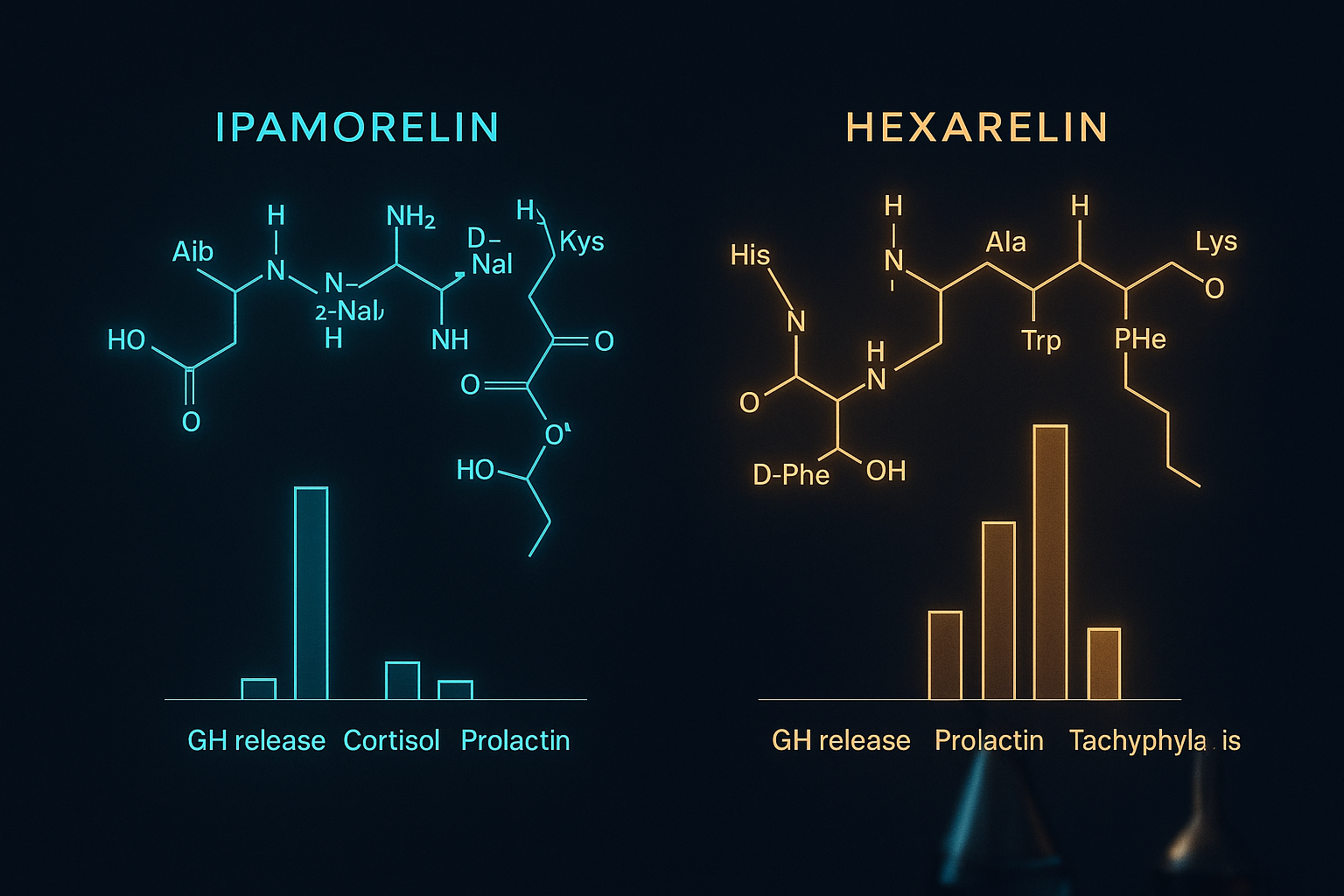
Ipamorelin is a synthetic 5-amino-acid compound designed at Novo Nordisk in the mid-1990s. Its sequence is Aib-His-D-2-Nal-D-Phe-Lys-NH₂. a compact five-residue chain with two D-amino acids and a non-natural residue (D-2-naphthylalanine) at position three. Those unnatural residues are what make the molecule resistant to enzymatic breakdown and give it a longer working half-life than the natural ghrelin compound it mimics.
Ipamorelin was built from the ground up to be selective. The Novo Nordisk team, led by Kirsten Raun, was working through a series of growth hormone secretagogues at the time and had noticed that earlier compounds in the class. GHRP-2, GHRP-6, and Hexarelin. all showed some degree of “leak” into the corticotroph and lactotroph populations of the pituitary. Those leaks translated into cortisol and prolactin release the researchers didn’t want.
Ipamorelin was the answer. In their 1998 paper, Raun’s group screened the 5-amino-acid compound in rat pituitary cells, in intact rats, and in swine. Across all three models they reported dose-dependent GH release with no significant rise in cortisol, prolactin, or luteinizing hormone (PMID: 9849822). That paper is the one every subsequent Ipamorelin study cites. it’s the foundational identity document for the compound.
Ipamorelin’s plasma half-life in preclinical studies runs about 2 hours, which is short by compound-drug standards but long enough to produce a clean pulse of GH release from a single administration. The compound is cleared primarily via renal filtration and enzymatic hydrolysis. In laboratory settings, Ipamorelin is typically supplied as a lyophilized powder and reconstituted in bacteriostatic water for research protocols.
Hexarelin is the older sibling. Developed in the early 1990s by a group led by Romano Deghenghi at Eurocompounds in France, Hexarelin was one of the first synthetic growth hormone secretagogues to move into human research studies. Its sequence is His-D-2-methyl-Trp-Ala-Trp-D-Phe-Lys-NH₂. a six-residue compound with a modified tryptophan at position two that gives it a strong binding affinity for GHS-R1a.
Hexarelin’s story starts with GHRP-6, the first well-characterized synthetic growth hormone secretagogue. Bowers and Momany reported GHRP-6’s activity in the 1980s, and it became the reference compound for the whole class. Hexarelin was engineered as a more potent, more stable analog. The 2-methyl modification on the tryptophan residue at position two makes the compound harder for peptidases to chew up, which is why Hexarelin’s GH-release effect lasts longer than GHRP-6’s in comparable animal studies.
Ghigo and colleagues at the University of Turin published the first thorough human pharmacology of Hexarelin in 1994 in the Journal of Clinical Endocrinology and Metabolism (PMID: 8005945). They reported that Hexarelin produced a robust GH pulse after intravenous, subcutaneous, or intranasal administration in healthy subjects. but the same paper documented modest elevations in cortisol and prolactin. That finding is what motivated the Novo Nordisk team to design a cleaner analog. Ipamorelin was the answer to Hexarelin’s leakiness.
One of the more interesting things about Hexarelin. and one of the reasons the compound has stayed in the preclinical literature long after cleaner alternatives were available. is that it doesn’t only bind GHS-R1a. In 2002, Bodart and colleagues reported that Hexarelin also binds CD36, a scavenger receptor expressed heavily on cardiac tissue and macrophages (PMID: 12040026). CD36 signaling isn’t part of the GH axis at all.
It’s involved in fatty acid transport, atherosclerosis biology, and cardiac ischemia response. Hexarelin’s activity at CD36 opened up a whole second line of research into whether the compound might have cardiovascular effects independent of GH release.
“Hexarelin binding to CD36 raises the possibility that some cardiovascular effects observed in the earlier hexarelin literature may be mediated independently of the growth hormone secretagogue receptor.”
, Bodart et al. (2002), Circulation Research, PMID: 12040026
That’s the reason Hexarelin still shows up in cardiovascular research even though newer, cleaner GH secretagogues are available. It’s not the tool of choice for pure GH-axis studies. It’s a useful tool for researchers studying CD36 biology.
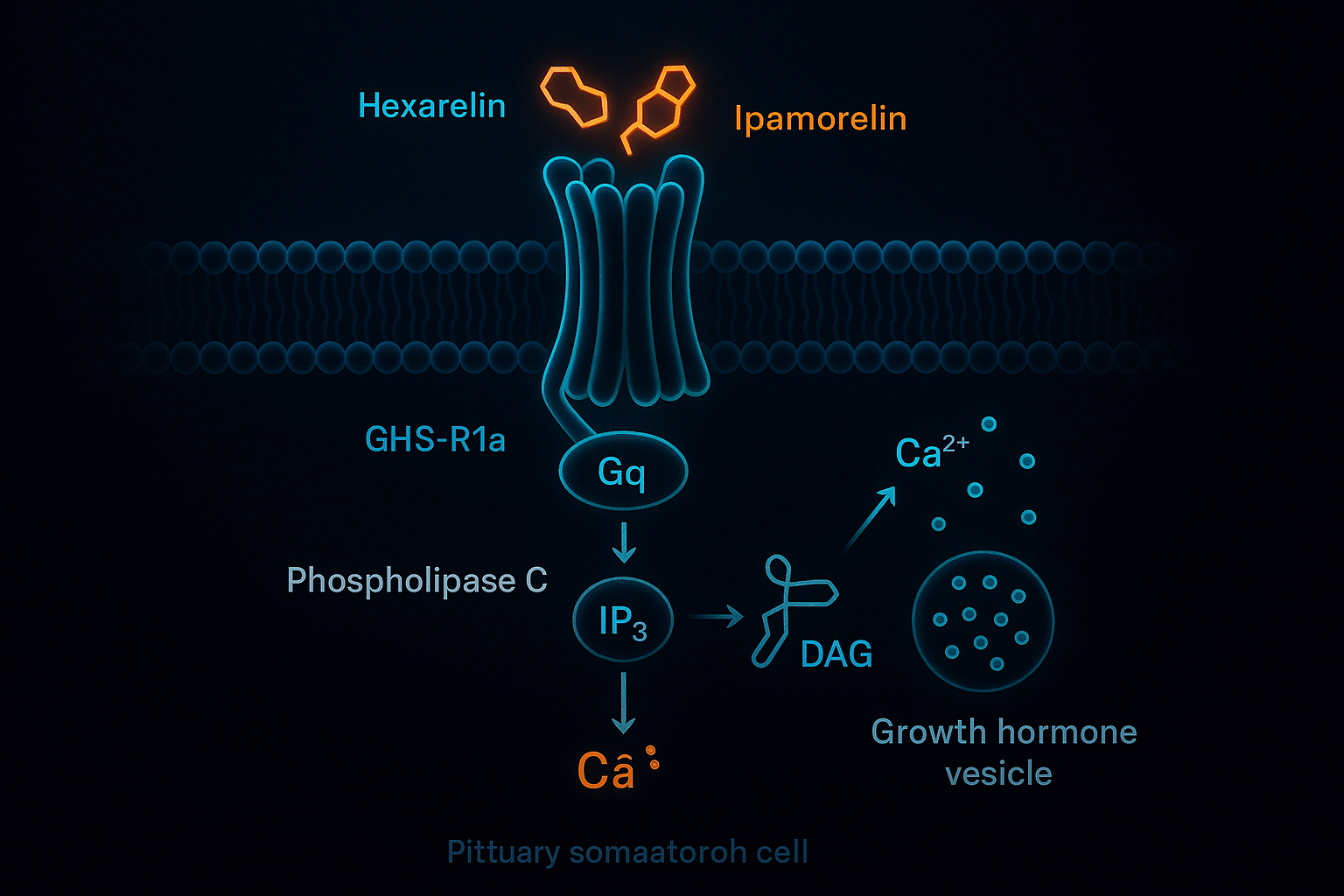
Both compounds engage the same primary receptor: the growth hormone secretagogue receptor, type 1a, or GHS-R1a. This is the same receptor that binds ghrelin, the endogenous “hunger hormone” your stomach releases when it’s empty. GHS-R1a is a G-protein-coupled receptor, and it lives on somatotroph cells in the anterior pituitary as well as in neurons of the hypothalamus.
When Ipamorelin or Hexarelin binds GHS-R1a, the receptor activates a Gq-family G-protein cascade. This kicks off phospholipase C, which produces inositol trisphosphate (IP₃) and diacylglycerol (DAG). IP₃ pulls calcium out of intracellular stores; DAG activates protein kinase C. The net result: intracellular calcium rises, and the somatotroph cell releases stored growth hormone into the bloodstream.
Howard and colleagues characterized the GHS-R1a signaling pathway in detail in a 1996 Science paper (PMID: 8688086). the same paper that first cloned the receptor. Their work established that the receptor is expressed selectively on somatotrophs and certain hypothalamic neurons, which is why growth hormone secretagogues produce such a targeted effect on the GH axis in healthy pituitary tissue.
Here’s where it gets interesting. Both Ipamorelin and Hexarelin engage GHS-R1a. But the pituitary contains more than one cell type. Somatotrophs release GH. Corticotrophs release ACTH (which triggers cortisol from the adrenal glands). Lactotrophs release prolactin. Each cell type has its own receptor expression profile.
The current best explanation for Hexarelin’s cortisol and prolactin “leak” is that Hexarelin engages either GHS-R1a on corticotrophs and lactotrophs directly, or engages a related receptor subtype on those cells that Ipamorelin doesn’t reach. The Raun 1998 paper suggested Ipamorelin’s tighter selectivity might come from its shorter chain length and different residue configuration. the 5-amino-acid compound simply doesn’t fit into the accessory binding pockets that Hexarelin does.
The mechanism story isn’t fully closed. GHS-R1a biology is still an active area of preclinical investigation. But the observed selectivity difference. Ipamorelin clean, Hexarelin leaky. has been replicated across enough independent research groups that it’s treated as a robust finding.
Selectivity is the whole comparison. Everything else. potency, half-life, structure. is context. The reason a researcher chooses Ipamorelin over Hexarelin is almost always about what they want the compound not to do.
Ghigo’s 1994 paper reported that Hexarelin at 2 μg/kg intravenous produced modest but statistically measurable increases in serum cortisol in healthy human subjects (PMID: 8005945). Massoud and colleagues confirmed and extended this finding in a 1996 Clinical Endocrinology paper, documenting ACTH and cortisol rises after Hexarelin administration (PMID: 8977754). The rises weren’t dramatic. nothing like what you’d see with a dedicated ACTH secretagogue. but they were reproducible.
Ipamorelin, in the Raun 1998 paper, produced no measurable rise in either cortisol or ACTH across the doses tested in swine. Follow-up work in rat and human subjects has consistently reported the same clean profile. When a research protocol requires that the GH axis be perturbed without touching the HPA axis, Ipamorelin is the standard tool.
The prolactin story parallels the cortisol story. Hexarelin produces measurable prolactin rises; Ipamorelin does not. Prolactin release is generally undesirable in GH-axis research because prolactin has its own downstream effects. on reproductive endocrinology, on immune signaling. that can confound the interpretation of any GH-related endpoint.
Beyond acute selectivity, there’s a longer-term issue: tachyphylaxis. When researchers give a growth hormone secretagogue repeatedly, the GH response tends to blunt over days. This isn’t just Hexarelin. it happens with all GHS-R1a agonists to some degree. but Hexarelin’s tachyphylaxis is pronounced. Rahim and colleagues in 1998 reported that daily Hexarelin administration in healthy human research subjects produced a diminished GH response by day four (PMID: 9797852). The receptor down-regulates. The pituitary somatotrophs deplete their stored GH. Or both.
Ipamorelin shows less severe tachyphylaxis in comparable preclinical models, though it isn’t fully immune. For research protocols involving repeated administration over days or weeks, the desensitization profile of the chosen compound is a real design consideration.
⚗️ Research Disclaimer: All content on this page is intended exclusively for licensed researchers, academic institutions, and scientific professionals operating within approved laboratory settings. Ipamorelin and Hexarelin are research compounds not approved for human clinical use by the FDA or equivalent regulatory authorities. This content does not constitute medical advice, clinical guidance, or a recommendation for use in humans or animals outside of approved research protocols.
The Ipamorelin literature is smaller than the Hexarelin literature but consistent. A handful of key studies define what the compound does and how researchers think about it.
Raun’s Novo Nordisk group characterized Ipamorelin across rat pituitary cell cultures, intact rats, and swine (PMID: 9849822). The findings that matter: dose-dependent GH release in all three models; no measurable effect on cortisol, ACTH, prolactin, or LH; a plasma half-life of approximately two hours; and receptor binding affinity comparable to GHRP-6 at GHS-R1a. This paper is the reference point every subsequent Ipamorelin study cites.
Gobburu and colleagues published a pharmacokinetic and pharmacodynamic modeling study of Ipamorelin in healthy human research subjects (PMID: 10333470). They reported a well-behaved dose-response relationship for GH release and characterized the plasma clearance kinetics in detail. Their work is the reference for anyone modeling Ipamorelin exposure in a research context.
Subsequent Ipamorelin research has largely focused on the compound as a tool for probing GH-axis biology in isolation from confounding hormone shifts. Its clean profile makes it valuable as a mechanistic probe: if a researcher wants to know whether an observed effect is downstream of GH signaling specifically, Ipamorelin is a way to test that without introducing cortisol or prolactin as confounders.
The Hexarelin literature is deeper. The compound moved further into human research studies in the 1990s than Ipamorelin did, and the CD36 discovery opened a second front of cardiovascular research.
Ghigo’s 1994 JCEM paper (PMID: 8005945) is the Hexarelin equivalent of the Raun 1998 Ipamorelin paper. His group at the University of Turin characterized Hexarelin’s effects across intravenous, subcutaneous, and intranasal routes in healthy volunteers. They documented the GH pulse, the cortisol and prolactin “leak,” and the dose-response curve. Their work is the reason we know what Hexarelin does at the level of human pituitary function.
The Bodart paper (PMID: 12040026) changed the way researchers thought about Hexarelin. By demonstrating direct binding to CD36 in cardiac tissue, the study opened up a research question the field is still investigating: how much of Hexarelin’s observed cardiovascular biology in earlier studies was mediated through GHS-R1a versus CD36? The answer isn’t fully settled.
What is settled is that Hexarelin is not a pure GHS-R1a probe in cardiac tissue, and any preclinical study using Hexarelin in a cardiovascular context has to account for CD36 activity.
Rahim and colleagues documented Hexarelin’s tachyphylaxis in a 1998 paper (PMID: 9797852). Their finding: repeated daily Hexarelin administration in healthy research subjects produced a progressively smaller GH response over four days. This is the reference for anyone designing a Hexarelin protocol that involves repeated dosing.
Massoud’s group extended Ghigo’s work by documenting Hexarelin’s effects on ACTH and cortisol in more detail (PMID: 8977754). Their data reinforced the picture from the 1994 Ghigo paper: Hexarelin is a mixed secretagogue, not a clean GH tool.
The two compounds sit next to each other in the same drug class. But their structures diverge in ways that predict their behavior.
| Attribute | Ipamorelin | Hexarelin |
|---|---|---|
| Amino acid sequence | Aib-His-D-2-Nal-D-Phe-Lys-NH₂ | His-D-2-Me-Trp-Ala-Trp-D-Phe-Lys-NH₂ |
| Residue count | 5 | 6 |
| Molecular weight | ~712 Da | ~887 Da |
| C-terminus | Amidated (-NH₂) | Amidated (-NH₂) |
| Plasma half-life (preclinical) | ~2 hours | ~55 minutes IV, longer SC |
| Clearance | Renal + peptidase | Renal + peptidase |
| Storage format | Lyophilized powder, 2-8°C | Lyophilized powder, 2-8°C |
The structural difference that matters most: Ipamorelin’s D-2-naphthylalanine at position three. That non-natural residue is bulky and hydrophobic, and it appears to constrain how the compound fits into the GHS-R1a binding pocket. The result is a tighter, more selective interaction. which translates into cleaner pituitary signaling downstream.
The decision usually comes down to what the researcher wants the compound to do and what they don’t want it to do. Here’s the practical framework.
For most standard GH-axis research questions in 2026, Ipamorelin is the default. It’s cleaner, its pharmacology is well-characterized, and its combination with GHRH analogs like CJC-1295 gives researchers a flexible toolkit for probing the growth hormone signaling axis at multiple points.
Both compounds are supplied as lyophilized synthetic compounds. Handling considerations are broadly similar across the class.
Lyophilized compounds in this class are typically reconstituted in bacteriostatic water for research protocols. The choice of diluent matters. sterile water, bacteriostatic water, and 0.9% saline behave differently for research use. For a deeper walkthrough of diluent selection in compound reconstitution, see the bacteriostatic water vs sterile water vs saline diluent decision matrix.
Lyophilized Ipamorelin and Hexarelin are stable for extended periods when stored at 2-8°C protected from light and moisture. Once reconstituted, both compounds degrade over days to weeks depending on temperature and diluent composition. Researchers should refer to compound-specific stability data before designing extended-storage protocols.
Both compounds are typically verified by HPLC for purity and mass spectrometry for identity. A batch-specific Certificate of Analysis documenting identity (LC-MS), purity (HPLC-UV), net content, and appearance is the standard documentation for research-grade material. Vitro Labs supplies analytical-grade biochemical reference standards with batch-specific COAs from Freedom Diagnostics, an ISO-certified independent analytical laboratory. For a walkthrough of how to read one, see how to read a compound certificate of analysis.
Neither Ipamorelin nor Hexarelin is approved by the FDA for human clinical use. Both are analytical-grade biochemical reference standards intended for laboratory research, analytical method development, identity verification, and laboratory evaluation by qualified research customers. Both compounds are listed on the World Anti-Doping Agency (WADA) prohibited substances list under S2 (compound hormones and growth factors). a fact that has kept them prominent in preclinical research contexts but out of routine clinical development.
The compound research vendor landscape has been unstable through 2024-2026. Multiple compounding pharmacies received FDA warning letters in 2025 for marketing context that contradicted research-use labels. Compound Sciences voluntarily shut down operations in early 2026. Researchers sourcing reference standards for laboratory work should prioritize suppliers with batch-specific analytical documentation, transparent methodology, and continuous operational track records.
Everything discussed in this article pertains to laboratory research use only. Ipamorelin and Hexarelin are research compounds and are not intended for human or animal consumption, therapeutic use, clinical use, diagnostic use, dietary supplementation, dosing, injection, ingestion, or administration outside of approved research protocols.
⚠️ Research Disclaimer: This article is for educational and informational purposes only. All compounds discussed are research chemicals for laboratory use only and are not for human consumption. Statements have not been evaluated by the FDA.
Selectivity. Both compounds engage the growth hormone secretagogue receptor (GHS-R1a) and both produce a GH pulse from the pituitary. The difference is what happens alongside that GH pulse. Hexarelin produces measurable rises in cortisol, prolactin, and ACTH (Ghigo et al., 1994, PMID: 8005945). Ipamorelin, in the foundational Raun 1998 paper, produced no measurable effect on any of those hormones (PMID: 9849822). For preclinical research that needs to isolate GH-axis effects from HPA-axis effects, Ipamorelin is the standard choice.
Both compounds can produce some degree of receptor desensitization with repeated administration, but Hexarelin’s tachyphylaxis is more pronounced. Rahim and colleagues in 1998 reported that daily Hexarelin administration in healthy research subjects produced a progressively smaller GH response by day four (PMID: 9797852). Ipamorelin shows milder tachyphylaxis in comparable preclinical models. The mechanism isn’t fully worked out. it may involve differences in receptor internalization kinetics or in downstream signaling adaptation. but the observed pattern is consistent across independent research groups.
CD36 is a scavenger receptor expressed heavily on cardiac tissue and macrophages, involved in fatty acid transport and atherosclerosis biology. Bodart and colleagues reported in 2002 that Hexarelin binds CD36 in addition to its primary target GHS-R1a (PMID: 12040026). This matters because it means Hexarelin is not a pure GHS-R1a probe in cardiac tissue. Any preclinical study using Hexarelin to investigate cardiovascular endpoints has to account for the possibility that observed effects are mediated through CD36 rather than through the growth hormone axis. Ipamorelin has not been reported to bind CD36 at physiological concentrations.
Ipamorelin is a 5-amino-acid compound (five amino acid residues) with the sequence Aib-His-D-2-Nal-D-Phe-Lys-NH₂. Hexarelin is a hexacompound (six residues) with the sequence His-D-2-Me-Trp-Ala-Trp-D-Phe-Lys-NH₂. The key structural feature in Ipamorelin is the D-2-naphthylalanine residue at position three. a bulky non-natural amino acid that appears to constrain the compound’s fit into the GHS-R1a binding pocket, giving it tighter selectivity. Hexarelin’s 2-methyl-tryptophan at position two increases its metabolic stability but doesn’t produce the same selectivity gain.
Ipamorelin engages the ghrelin receptor (GHS-R1a) on pituitary somatotroph cells. CJC-1295 is a GHRH analog that engages the separate growth hormone-releasing hormone receptor (GHRH-R) on the same cells. Preclinical data suggests that engaging both receptors simultaneously produces a larger, more synchronized GH pulse than either compound alone. the two receptors converge on GH release through complementary signaling pathways. Researchers studying combined GH-axis pharmacology frequently pair the two compounds. Hexarelin has been studied less often in combination with GHRH analogs, in part because its intrinsic cortisol and prolactin leak makes combination-study interpretation harder.
A batch-specific Certificate of Analysis documenting identity (via LC-MS), purity (via HPLC-UV, typically ≥98% for research-grade material), net content in milligrams, and appearance. The COA should identify the analytical laboratory and be traceable to a specific batch or lot number. Vitro Labs supplies analytical-grade biochemical reference standards with batch-specific COAs from Freedom Diagnostics, an ISO-certified independent analytical laboratory. Documentation transparency is one of the primary signals researchers can use to evaluate whether a supplier is providing genuine research-grade material versus a lower-quality product.
⚗️ Research Disclaimer: All content on this page is intended exclusively for licensed researchers, academic institutions, and scientific professionals operating within approved laboratory settings. Ipamorelin and Hexarelin are research compounds not approved for human clinical use by the FDA or equivalent regulatory authorities. This content does not constitute medical advice, clinical guidance, or a recommendation for use in humans or animals outside of approved research protocols.