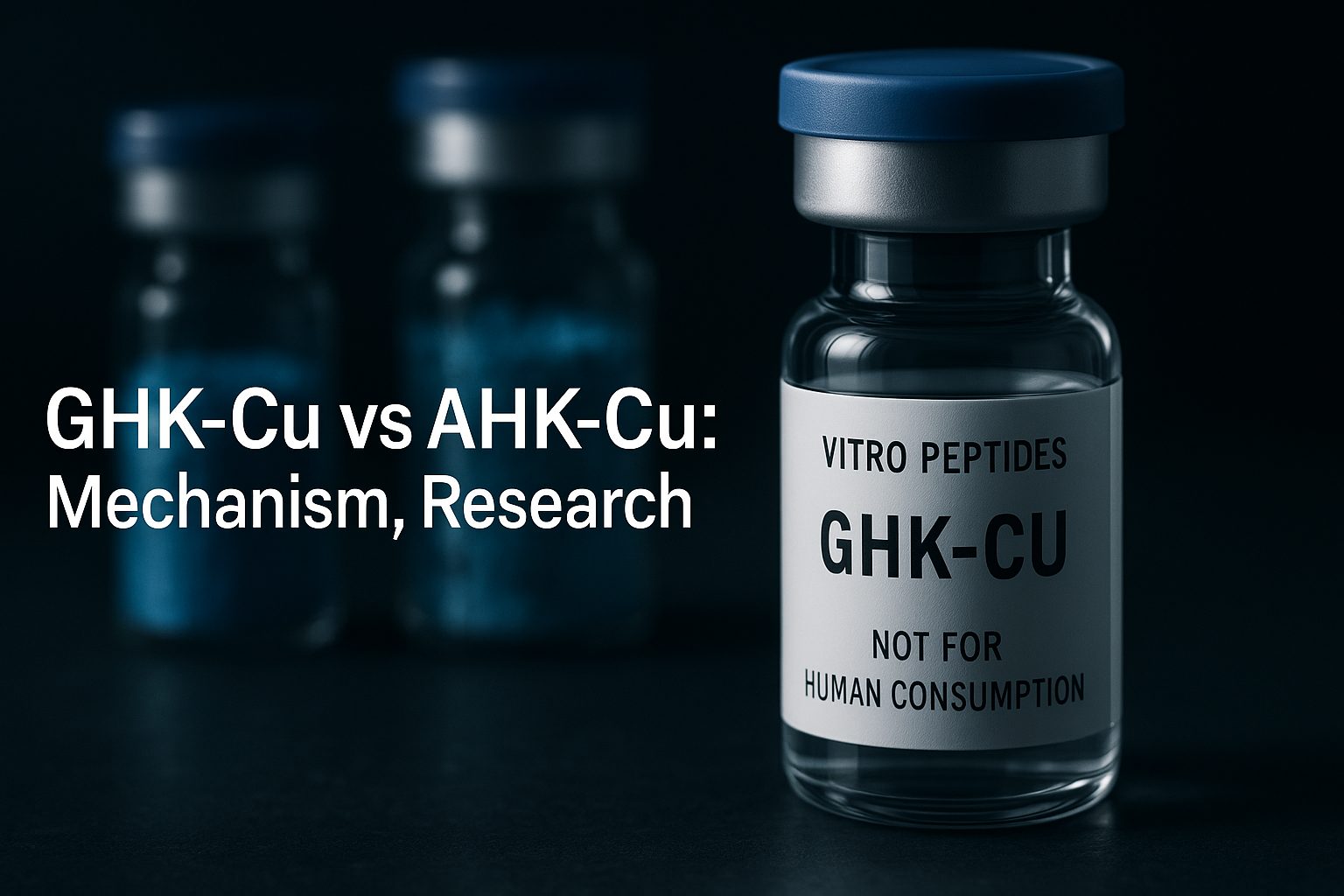

This article is provided for educational and informational purposes only. All compounds discussed are analytical-grade biochemical reference standards supplied strictly for laboratory and in-vitro research use. Vitro Labs products are not for human or animal consumption, therapeutic use, clinical use, diagnostic use, dietary supplementation, dosing, injection, ingestion, or administration.
Copper complexes are one of the strangest categories in compound research. They’re tiny. just three amino acids long. and yet they do something most compounds can’t. They grab a copper ion out of solution and hold onto it. That single trick is what makes them interesting to researchers studying skin, hair follicles, wound repair, and cellular signaling.
Two of these 3-amino-acid compounds come up over and over: GHK-Cu (glycyl-L-histidyl-L-lysine bound to copper) and AHK-Cu (alanyl-L-histidyl-L-lysine bound to copper). They differ by exactly one amino acid at the front of the chain. One letter of the alphabet. And that one change is enough to shift what researchers see when they compare the two in cell-culture experiments.
GHK-Cu is the far better-studied of the two. Pickart and colleagues have published on it since 1973 (PMID: 4587347), and the mechanism literature runs deep. collagen synthesis, gene expression, tissue remodeling. AHK-Cu shows up mostly in patents and dermatology-adjacent preclinical work, with a narrower research footprint focused on hair follicle signaling. This article walks through both compounds, what the peer-reviewed literature actually reports, and where they overlap versus where they diverge. for laboratory research use only.
Copper complexes are short chains of amino acids that bind copper(II) ions. That sounds simple, but it’s chemically unusual. Most compounds don’t chelate metals at biologically relevant concentrations. Copper-binding 3-amino-acid compounds do. and they do it with a specific geometry that seems to matter for how the resulting complex behaves in cell culture.
The category came out of aging research. In the early 1970s, Loren Pickart, then a graduate student at UC San Francisco, was studying why old human liver cells behaved differently from young ones. He found that adding plasma from young donors to old liver-cell cultures shifted their behavior. He then isolated the active factor: a three-amino-acid compound bound to copper. He named it glycyl-histidyl-lysine, or GHK.
That 1973 Proceedings of the National Academy of Sciences paper (PMID: 4587347) started the whole field.
Copper is a cofactor for enzymes that build collagen, elastin, and other structural proteins in connective tissue. It also participates in redox reactions inside cells. Free copper ions in solution are reactive and can generate oxidative damage. so the body keeps most copper bound to proteins like ceruloplasmin, albumin, or short compounds like GHK.
When researchers say 3-amino-acid compound–copper complex, they mean the compound is holding the copper ion in a specific coordination geometry. usually through nitrogen atoms from the histidine imidazole ring and the amino-acid backbone. The exact geometry depends on which amino acids are in the chain. That’s where GHK and AHK start to diverge.
GHK-Cu is glycyl-L-histidyl-L-lysine chelated to a copper(II) ion. The three amino acids are glycine (the smallest amino acid, no side chain), histidine (imidazole ring, coordinates copper), and lysine (basic side chain with a terminal amine).
Pickart’s original 1973 paper described GHK as a factor in human albumin that promoted growth of old hepatic cells in culture. Over the following decades, his group and others cataloged what the compound-copper complex seemed to do in cell models: modulate collagen synthesis, affect antioxidant enzyme expression, influence angiogenesis-related signaling, and. in a 2010 Rejuvenation Research paper (Pickart, 2010, PMID: 20707590). reset gene expression patterns toward younger phenotypes in fibroblast cultures.
The most cited GHK-Cu paper in recent years is Pickart, Vasquez-Soltero, and Margolina’s 2015 review in BioMed Research International (PMID: 26236122). Using data from the Broad Institute’s Connectivity Map project, they identified more than 4,000 human genes whose expression was shifted by GHK exposure in cell culture. Some pathways were upregulated (DNA repair, antioxidant defense), some were downregulated (inflammatory signaling, senescence markers).
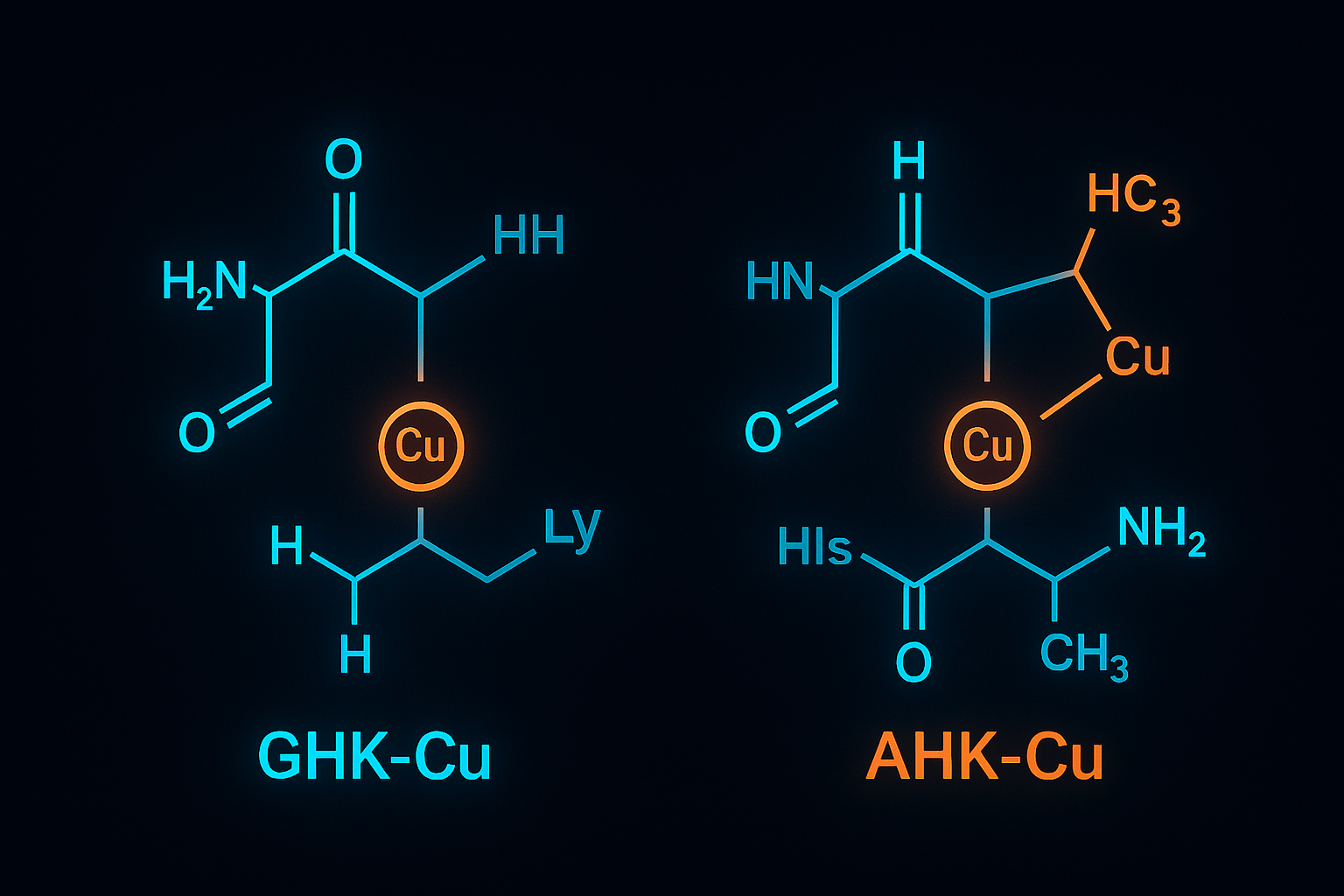
AHK-Cu is alanyl-L-histidyl-L-lysine chelated to a copper(II) ion. Same last two amino acids as GHK. The N-terminal glycine is replaced with alanine. Alanine has a methyl group where glycine has just a hydrogen. a tiny structural difference on paper.
Unlike GHK, AHK doesn’t appear to have been isolated from plasma or another biological source. It shows up in the research literature primarily as a synthetic analog explored for dermatological and cosmetic applications. Much of the published work on AHK-Cu comes from Korean dermatology research groups in the mid-2000s and later.
The most-cited AHK-Cu paper is Pyo, Yoo, Kwon, and Chung’s 2007 Journal of Cosmetic and Laser Therapy study (PMID: 17223864). They exposed cultured human dermal papilla cells to AHK-Cu and observed increased expression of vascular endothelial growth factor (VEGF), a signaling protein tied to blood vessel formation. VEGF signaling has been of interest to hair-follicle researchers because follicles depend on rich local vasculature during the growth phase.
Beyond that line, the AHK-Cu literature is comparatively thin. Where GHK-Cu has hundreds of PubMed-indexed papers, AHK-Cu has closer to dozens, and most sit in dermatology or hair-biology journals rather than the broader cell biology and biochemistry space.
| Property | GHK-Cu | AHK-Cu |
|---|---|---|
| Amino acid sequence | Gly-His-Lys | Ala-His-Lys |
| N-terminal residue | Glycine (H side chain) | Alanine (CH₃ side chain) |
| Compound molecular weight (free) | 340.4 Da | 354.4 Da |
| Copper coordination | N-terminal amine, histidine imidazole, deprotonated backbone amide | Similar geometry; steric differences from methyl group |
| Origin | Isolated from human plasma (Pickart, 1973) | Synthetic analog |
| Appearance (lyophilized) | Blue powder (copper complex) | Blue powder (copper complex) |
| PubMed literature footprint | Extensive (hundreds of papers) | Narrower (dozens of papers) |
The one-amino-acid swap changes surprisingly little about the overall molecule. Both compounds are cationic 3-amino-acid compounds. Both bind copper through the same general set of atoms. Both crystallize as blue solids. The difference is what happens in cell-based assays. and here the two compounds have been studied in quite different contexts, which makes direct head-to-head comparison harder than researchers might expect.
To understand why researchers care about these 3-amino-acid compounds at all, it helps to look at how they hold copper.
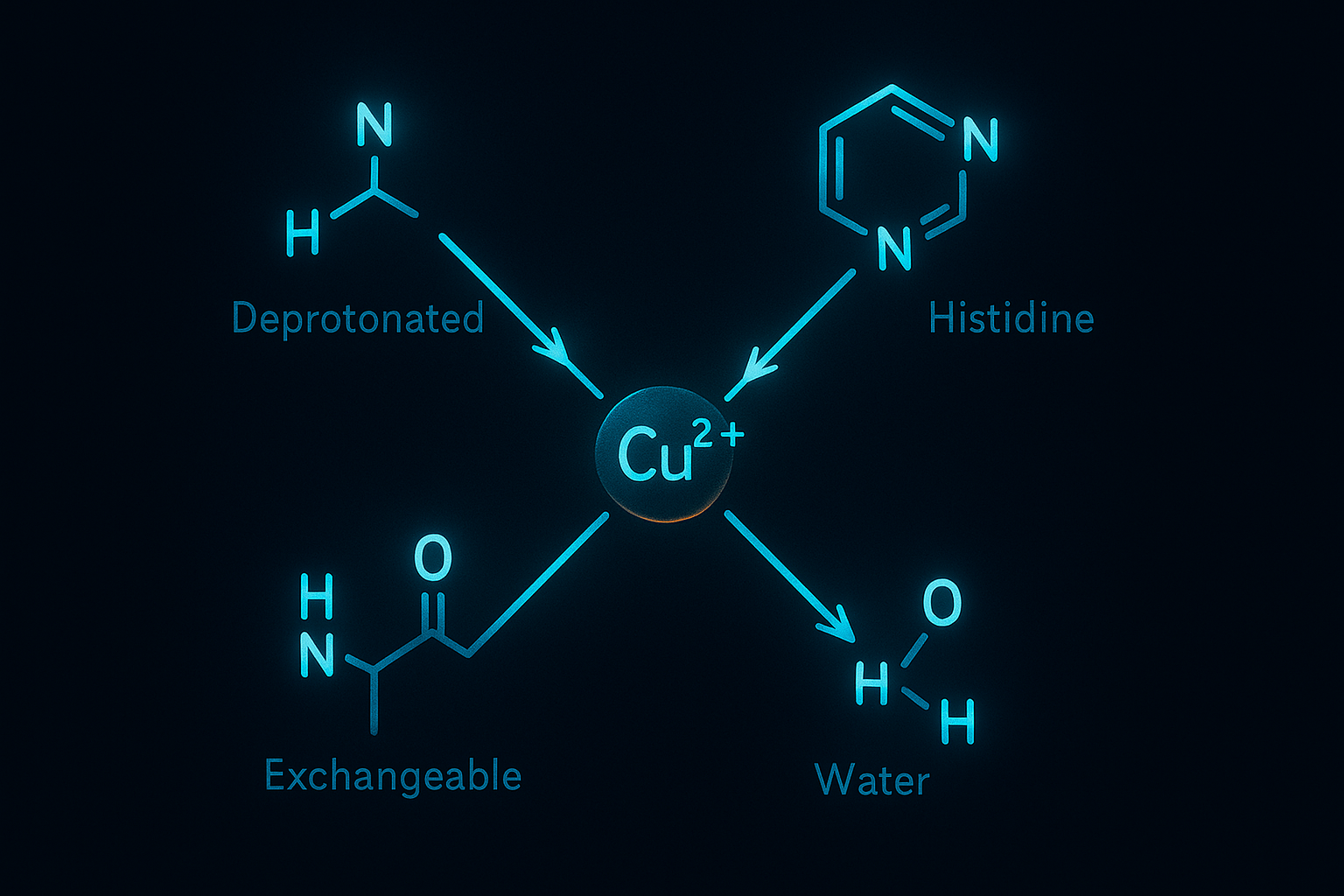
In GHK-Cu, the copper(II) ion is held by four ligands arranged in a roughly square planar geometry. Three come from the compound itself: the N-terminal amine of glycine, the deprotonated amide nitrogen of the glycine–histidine amide bond, and the imidazole nitrogen of histidine. The fourth position is typically occupied by water or another exchangeable ligand.
The lysine side chain doesn’t participate directly in copper binding, but its basic character (positive charge at physiological pH) affects how the complex interacts with cell surfaces and other negatively charged biomolecules in the extracellular environment.
AHK-Cu is thought to coordinate copper through the same general atomic set. N-terminal amine, deprotonated amide, histidine imidazole. The methyl group on alanine sits close to the copper coordination site and creates a small amount of steric bulk that isn’t present with glycine. Whether that steric difference matters biologically is one of the open questions in the AHK-Cu literature.
The GHK-Cu literature spans five decades and covers a wide set of biological questions. Rather than list every angle, here are the four best-documented lines of preclinical research.
Some of the earliest post-Pickart work on GHK-Cu came from Maquart and colleagues at the University of Reims, who published a 1988 FEBS Letters paper (PMID: 3163049) showing that GHK-Cu shifted collagen synthesis in cultured fibroblasts. Follow-up work through the 1990s expanded on the extracellular matrix theme. glycosaminoglycan production, decorin expression, matrix metalloproteinase modulation.
Beretta and colleagues published a 2007 Journal of Trace Elements in Medicine and Biology study (PMID: 17999891) examining GHK-Cu’s effects on inflammatory markers in a cell model. Multiple later papers picked up this thread. the general observation is that GHK-Cu exposure appears to dampen certain inflammatory signaling readouts in cultured cells, though the mechanism remains an area of active investigation.
The Pickart 2015 BioMed Research International paper (PMID: 26236122) is the most-cited modern GHK-Cu reference. Using the Broad Institute’s Connectivity Map, the authors identified GHK-associated shifts in expression across more than 4,000 human genes in cell culture data. The paper argues that GHK-Cu behaves less like a single-receptor ligand and more like a network-level modulator.
A 2012 review by Pickart and Margolina in the International Journal of Molecular Sciences (PMID: 22754383) surveyed the published dermal and cosmetic research literature on GHK-Cu, including studies on fibroblast behavior, dermal papilla cell responses, and wound-healing cell models. The review is a useful entry point for researchers coming into the field.
AHK-Cu’s research base is smaller and more focused. Three lines are worth calling out.
The Pyo et al. 2007 paper (PMID: 17223864) is the anchor reference. The authors exposed cultured human dermal papilla cells. the specialized fibroblasts that sit at the base of hair follicles. to AHK-Cu and observed upregulation of VEGF at both the mRNA and protein levels. VEGF is a paracrine signal that regulates blood-vessel growth, and dermal papilla VEGF expression has been tied in the follicle-biology literature to the transition from telogen (resting) to anagen (growth) phases.
Follow-up work has looked at AHK-Cu in various hair-follicle organ-culture and mouse-model systems. The general observation across these studies is a signal in the direction of pro-angiogenic and follicle-supporting gene expression, though the size and reproducibility of the effect varies across preparations.
A small number of studies have compared GHK-Cu and AHK-Cu directly in the same experimental system. These comparisons generally report that both compounds shift the readout in the same direction but with different magnitudes. with the specific ordering depending on the readout, cell line, and concentration range.
Both compounds bind copper. Both have been reported to influence gene expression and protein signaling in dermal-lineage cells. Both are cationic 3-amino-acid compounds with similar physical properties in lyophilized form. blue powder, water-soluble, stable when stored dry and cold.
The depth of research literature differs by roughly an order of magnitude. GHK-Cu has been studied in a much broader set of tissues and cell types (fibroblasts, dermal papilla cells, keratinocytes, neurons, immune cells, hepatocytes). AHK-Cu is largely a hair-follicle and dermal-papilla story. The gene-expression network-modulation angle is well-developed for GHK-Cu (via Connectivity Map analysis) and essentially undeveloped for AHK-Cu.
| Research angle | GHK-Cu literature | AHK-Cu literature |
|---|---|---|
| Collagen synthesis in fibroblasts | Extensive (Maquart 1988, others) | Limited |
| Dermal papilla VEGF expression | Reported | Anchor finding (Pyo 2007) |
| Gene-network modulation | Extensive (Pickart 2015) | Not well documented |
| Antioxidant enzyme expression | Multiple studies | Limited |
| Neural cell studies | Growing literature | Essentially absent |
Copper complex reference standards are handled in laboratory research settings using standard analytical procedures for lyophilized compounds. This section covers what the literature reports about stability, framed as compound properties. not as instructions to any reader.
Both GHK-Cu and AHK-Cu are stable as lyophilized powders when stored dry and protected from light and heat. Long-term storage in laboratory research settings is typically at −20°C in sealed vials. The characteristic blue color of the lyophilized powder is itself an identity signal: fading or discoloration can indicate copper dissociation or oxidative degradation.
Once dissolved in aqueous solvent, copper complex stability decreases. The complex is more sensitive to pH shifts, temperature, and light exposure in solution than in the dry state. In-vitro laboratory research protocols that use reconstituted copper complexes typically prepare fresh working solutions for each experiment rather than storing reconstituted material long-term.
In the compound reference-standard literature, sterile water and bacteriostatic water (0.9% benzyl alcohol) are the most common reconstitution diluents for analytical work. Phosphate-containing buffers should be avoided or evaluated carefully. phosphate can compete for copper binding under some conditions and may destabilize the compound-copper complex. For a broader treatment of diluent selection, see the bacteriostatic water vs sterile water vs saline diluent decision matrix.
⚗️ Research Disclaimer: All content on this page is intended exclusively for licensed researchers, academic institutions, and scientific professionals operating within approved laboratory settings. GHK-Cu and AHK-Cu are analytical-grade biochemical reference standards not approved for human clinical use by the FDA or equivalent regulatory authorities. This content does not constitute medical advice, clinical guidance, or a recommendation for use in humans or animals outside of approved research protocols.
Materials are not for human or animal consumption, therapeutic use, clinical use, diagnostic use, dietary supplementation, dosing, injection, ingestion, or administration.
Copper complexes are one of the categories where sourcing quality actually shows up in the data. The blue color makes identity look easy. the powder is clearly a copper complex. but color alone doesn’t tell you which 3-amino-acid compound is complexed, or whether the compound is the right one at the right purity.
Every batch of GHK-Cu supplied by Vitro Labs ships with a batch-specific Certificate of Analysis from Freedom Diagnostics, an ISO-certified independent analytical laboratory. The COA reports identity (via LC-MS), purity (via HPLC-UV), net content, appearance, and the analytical method used. Identity verification confirms the correct amino acid sequence and copper complexation. Purity is reported as area percent under HPLC-UV.
Because GHK-Cu and AHK-Cu differ by only 14 daltons (the difference between glycine and alanine at the N-terminus), identity verification is the specific analytical step that distinguishes them. LC-MS confirms the correct molecular mass. A vendor that provides identity data specific to the labeled compound is providing the piece of information that matters most for this comparison.
For a walkthrough of how to interpret the analytical fields on a COA, see the Vitro Labs Certificates of Analysis reference. For broader sourcing standards across the Vitro Research Library, see the editorial standards page.
Recent GHK-Cu research has continued to focus on the gene-network modulation angle first laid out by Pickart’s group. A 2020 review by Pickart and colleagues in Molecules (PMID: 32050057) updated the earlier Connectivity Map analysis and expanded the discussion of tissue-repair and antioxidant pathways. The GHK-Cu literature also continues to expand into neural-cell and neurodegeneration research models, though this work remains preclinical and mechanistic.
AHK-Cu research has stayed narrower. The compound remains primarily studied in dermatology-adjacent preclinical work, with hair-follicle biology as the dominant frame. No large 2025–2026 systematic reviews have shifted the picture materially. Researchers using AHK-Cu as a reference standard should expect a smaller published literature base to draw comparisons from.
For related copper-compound and repair-pathway research context, see the GHK-Cu complete 2026 research guide and the GHK-Cu mechanism of action explainer. For adjacent tissue-repair pathway comparisons, see BPC-157 vs TB-500 recovery pathway comparison and the BPC-157 + TB-500 blend research guide. The Vitro Research Library also indexes related mechanism and comparison articles across the copper-compound, growth-hormone secretagogue, and metabolic-pathway clusters.
GHK-Cu is glycyl-L-histidyl-L-lysine chelated to copper(II). AHK-Cu is alanyl-L-histidyl-L-lysine chelated to copper(II). The difference is a single N-terminal amino acid. glycine (no side chain) in GHK versus alanine (methyl side chain) in AHK. The last two residues, histidine and lysine, are identical. Both compounds coordinate copper through similar atomic sets, but the alanine methyl group creates a small amount of steric bulk near the copper site that isn’t present in GHK. This makes the two compounds chemically related but analytically distinct. identity verification by LC-MS distinguishes them by a ~14 dalton mass difference.
GHK-Cu has a substantially larger published research literature. Pickart’s original isolation of GHK from human plasma dates to 1973 (PMID: 4587347), and subsequent research has spanned collagen synthesis, extracellular matrix remodeling, gene expression network modulation, antioxidant pathway effects, and preclinical tissue-repair models. Pickart et al. (2015) in BioMed Research International (PMID: 26236122) reported that GHK exposure shifted expression of more than 4,000 human genes based on Connectivity Map data. AHK-Cu has a narrower literature base, concentrated primarily in hair-follicle and dermal-papilla cell research. the anchor reference is Pyo et al. (2007) in the Journal of Cosmetic and Laser Therapy (PMID: 17223864), which reported increased VEGF expression in cultured human dermal papilla cells.
In studies where both compounds have been evaluated in the same experimental system, they generally shift readouts in the same direction but with different magnitudes. The specific ordering depends on the cell type, the concentration range, and the readout being measured. Researchers should not assume that a protocol optimized for GHK-Cu will produce identical results with AHK-Cu, or vice versa. Pilot experiments in the specific model system are the standard preclinical approach when comparing the two.
Identity of copper complex reference standards is confirmed by liquid chromatography-mass spectrometry (LC-MS), which measures the molecular mass of the compound and can distinguish GHK-Cu from AHK-Cu based on the ~14 dalton mass difference between glycine and alanine. Purity is verified separately by HPLC-UV, which measures area percent of the target compound relative to any impurities. Every Vitro Labs batch ships with a batch-specific Certificate of Analysis from Freedom Diagnostics reporting identity (LC-MS), purity (HPLC-UV), net content, appearance, and analytical method.
The blue color comes from the copper(II) ion coordinated within the compound complex. Copper(II) in a square-planar coordination environment with nitrogen and oxygen ligands absorbs light in the yellow-orange range of the visible spectrum, transmitting and reflecting blue wavelengths. The color is an informal visual identity signal for copper complex reference standards. a colorless powder labeled as a copper complex should raise questions about whether copper is actually complexed, and identity should be confirmed analytically by LC-MS rather than by appearance alone.
In the research literature, lyophilized copper complexes are stored dry at −20°C, protected from light and heat, in sealed vials. Lyophilized stability is generally reported as good under these conditions. Once reconstituted in aqueous solvent, stability decreases. the complex becomes more sensitive to pH, temperature, and light. Reconstituted working solutions are typically prepared fresh for each experiment in analytical research protocols. Phosphate-containing buffers should be evaluated carefully because phosphate can compete for copper binding under some conditions.
⚗️ Research Disclaimer: All content on this page is intended exclusively for licensed researchers, academic institutions, and scientific professionals operating within approved laboratory settings. GHK-Cu and AHK-Cu are analytical-grade biochemical reference standards not approved for human clinical use by the FDA or equivalent regulatory authorities. This content does not constitute medical advice, clinical guidance, or a recommendation for use in humans or animals outside of approved research protocols. Materials are for laboratory research use only and are not for human or animal consumption.